

Healthcare professionals do not all perform the same type of work, so they do not necessarily need the same type of workwear. A nurse working long hospital shifts may prioritize mobility and storage, while a physician may place greater emphasis on professional presentation and layering. Medical assistants, dental professionals, veterinary teams, students, and other healthcare workers can have their own practical requirements as well.
Choosing appropriate healthcare workwear starts with understanding the demands of the role. Work environment, movement, shift length, dress-code requirements, climate, storage needs, and personal fit preferences all influence which garments and accessories are most useful.
The goal is not simply to find attractive uniforms. Effective healthcare workwear should provide a practical combination of comfort, mobility, coverage, durability, organization, and professional appearance.
Key Takeaways
- Healthcare workwear should be selected according to the specific demands of the profession.
- Nurses often benefit from comfortable, durable scrubs with practical storage and layering options.
- Physicians may prioritize a combination of professional appearance, mobility, and appropriate clinical layers.
- Medical assistants need workwear that can transition between clinical and administrative tasks.
- Dental professionals may benefit from comfortable, easy-care garments that support frequent movement.
- Veterinary professionals may need durable workwear suited to active environments.
- Healthcare students should prioritize school and clinical-site uniform requirements.
- Fit is important regardless of profession because healthcare workers spend significant time moving.
- Fabric selection can influence stretch, breathability, durability, and maintenance.
- Nursing bags and other storage accessories can reduce the need to overload scrub pockets.
- Workplace dress codes should always take priority over personal style preferences.
- A practical wardrobe usually includes core uniforms, backup sets, appropriate layers, and role-specific accessories.
Why Should Healthcare Workwear Be Chosen by Profession?
Healthcare is a broad field encompassing many different working environments.
A hospital nurse, dental assistant, physician, veterinary technician, and medical student may all wear scrubs, but their daily responsibilities can be very different.
For example, a nurse may spend most of a shift walking between patient rooms, while a physician may divide time between examinations, documentation, consultations, and administrative work.
These differences affect workwear requirements.
Important considerations include:
- Amount of movement
- Shift duration
- Work environment
- Temperature
- Patient interaction
- Equipment carried
- Storage requirements
- Workplace dress code
- Frequency of laundering
- Required level of coverage
Choosing workwear based on these factors can produce a more practical wardrobe than choosing garments based solely on appearance.
What Should Every Healthcare Professional Consider?
Regardless of profession, several fundamental factors apply to most healthcare workwear decisions.
Fit
The uniform should allow natural movement without excessive tightness or unnecessary fabric.
Fabric
Consider:
- Stretch
- Breathability
- Weight
- Durability
- Softness
- Easy-care characteristics
Mobility
Healthcare professionals may need to bend, reach, sit, walk, squat, and move equipment.
Coverage
Garments should provide appropriate coverage throughout normal work movements.
Storage
Determine which items need immediate access and which can be stored in a bag or other appropriate location.
Workplace Requirements
Uniform colors, styles, sleeves, layers, and other features may be regulated by an employer, school, or clinical facility.
Healthcare Workwear for Nurses
Nursing is one of the most physically active healthcare professions, and many nurses spend extended periods on their feet.

Depending on the role and setting, a nurse may spend a shift:
- Walking between patient rooms
- Standing beside patients
- Assisting with movement
- Documenting care
- Carrying approved clinical tools
- Responding to changing patient needs
- Moving between different areas of a facility
This makes mobility and comfort particularly important.
What Should Nurses Look for in Scrubs?
Nurses may want to prioritize:
- Comfortable fit
- Stretch
- Breathability
- Durable construction
- Practical pockets
- Comfortable waistbands
- Appropriate inseam
- Easy-care fabrics
Long shifts can make minor fit problems increasingly noticeable.
A scrub top that restricts the shoulders or pants with an uncomfortable waistband may become distracting after several hours.
How Many Scrub Sets Should Nurses Own?
The appropriate number depends on shift frequency and laundry habits.
A nurse working several consecutive days may need enough sets to cover those shifts plus backup uniforms.
Having additional sets can also be useful for unexpected spills, stains, or laundry delays.
A practical nursing uniform wardrobe should therefore be based on the actual work schedule rather than an arbitrary number of outfits.
Healthcare Workwear for Physicians
Physicians can work in hospitals, outpatient clinics, private practices, specialty facilities, and other environments.
Their workwear requirements can therefore vary considerably.
Some physicians primarily wear scrubs, while others may combine scrubs with lab coats or other professional garments.
What Should Physicians Consider?
Key factors can include:
- Professional appearance
- Comfortable movement
- Appropriate coverage
- Easy-care fabrics
- Layering
- Pocket functionality
- Workplace requirements
Physicians who move between clinical and administrative areas may particularly value versatile garments that remain appropriate across different parts of the workday.
Should Physicians Choose Tailored or Relaxed Scrubs?
Either option can work.
A tailored scrub can provide a more structured appearance, while a relaxed fit can provide additional room for movement.
The best choice depends on:
- Body proportions
- Work activities
- Personal preference
- Fabric stretch
- Workplace standards
Professional appearance does not require excessively fitted clothing.
Healthcare Workwear for Medical Assistants
Medical assistants can perform both clinical and administrative responsibilities.
Depending on the workplace, duties may include:
- Preparing examination rooms
- Assisting with patient intake
- Recording information
- Supporting clinical procedures
- Scheduling or administrative tasks
- Moving between different areas of a facility
This combination makes versatility particularly useful.
What Should Medical Assistants Look For?
A practical uniform may include:
- Comfortable scrub tops
- Flexible scrub pants
- Practical pockets
- Easy-care fabrics
- Appropriate layering pieces
- A small work bag when permitted
Medical assistants may benefit from garments that look professional without restricting movement.
Healthcare Workwear for Dental Professionals
Dental professionals often work in relatively controlled clinical environments, but their work still involves frequent arm movement, leaning, reaching, and extended periods of standing or sitting.

Dental teams may include:
- Dentists
- Dental hygienists
- Dental assistants
- Dental laboratory professionals
What Should Dental Professionals Consider?
Useful considerations include:
- Comfortable upper-body movement
- Appropriate sleeve design
- Breathable fabric
- Easy-care construction
- Secure fit
- Appropriate coverage
- Professional appearance
A scrub top should allow the wearer to move the arms comfortably without excessive pulling across the shoulders.
Pants should also allow comfortable movement while sitting and standing.
Healthcare Workwear for Veterinary Professionals
Veterinary environments can be more physically variable than many human healthcare settings.
Veterinary professionals may work with:
- Animals of different sizes
- Equipment
- Examination tables
- Treatment areas
- Outdoor or transitional spaces
- Cleaning and preparation areas
These conditions can place additional demands on clothing.
What Should Veterinary Professionals Look For?
Durability and mobility may be especially important.
Consider:
- Durable fabrics
- Comfortable stretch
- Secure pockets
- Appropriate coverage
- Easy-care materials
- Comfortable fit
Veterinary professionals may also benefit from keeping personal belongings in a dedicated work bag rather than overloading uniform pockets.
Healthcare Workwear for Nursing Students
Students often need to satisfy both educational and clinical requirements.
A nursing student may have to follow rules regarding:
- Scrub colors
- Uniform styles
- Shoe requirements
- Identification
- Accessories
- Clinical-site appearance
These requirements should be checked before purchasing a large wardrobe.
How Should Students Build a Scrub Wardrobe?
Students can start with the garments required by their program and clinical placements.
A practical student wardrobe may include:
- Required scrub sets
- One or more backup sets
- Appropriate underscrubs
- A permitted scrub jacket
- Nursing bag
- Stethoscope case
A student does not necessarily need a large collection of styles.
It is usually more useful to have enough reliable uniforms to cover the academic and clinical schedule.
Healthcare Workwear for Medical Students
Medical students can move between classrooms, laboratories, hospitals, clinics, and other learning environments.
Their clothing requirements may therefore vary throughout the week.
What Should Medical Students Consider?
Look for workwear that can accommodate:
- Classroom activities
- Clinical rotations
- Long periods of standing
- Walking between facilities
- Documentation
- Equipment storage
Students should also confirm whether each clinical placement has specific uniform requirements.
Healthcare Workwear for Allied Health Professionals
Allied health encompasses a wide range of roles, so requirements can differ considerably.
Depending on the profession, workers may spend much of their time:
- Treating patients
- Conducting assessments
- Moving equipment
- Demonstrating exercises
- Walking between treatment areas
- Completing documentation
Physical therapists, occupational therapists, respiratory therapists, imaging professionals, and other healthcare workers may therefore prioritize different combinations of flexibility, coverage, durability, and storage.
How Should Allied Health Professionals Choose Workwear?
Start by evaluating the most common movements involved in the role.
A professional who frequently demonstrates physical movements may prioritize stretch and mobility.
Someone who spends more time documenting or consulting may prioritize comfort and professional presentation.
Healthcare Workwear for Long Shifts
Long shifts can make clothing comfort especially important.
Whether the shift lasts eight, ten, or twelve hours, healthcare professionals should evaluate how garments perform over extended periods.
Consider:
- Waistband comfort
- Shoulder mobility
- Fabric breathability
- Stretch
- Inseam
- Pocket placement
- Layering
A garment that feels acceptable for an hour may become uncomfortable after many hours of wear.
How Does Fabric Choice Vary by Profession?
Different professions may place different demands on fabric.
Active roles
Professionals who spend much of the day moving may benefit from:
- Stretch
- Breathability
- Lightweight construction
- Moisture-management characteristics
Stationary clinical roles
Professionals who spend more time standing or sitting may prioritize:
- Softness
- Comfortable structure
- Waistband comfort
- Appropriate layering
Mixed clinical and administrative roles
These professionals may want:
- Versatile styling
- Easy-care fabrics
- A polished appearance
- Comfortable movement
There is no universal best fabric.
The right choice depends on the actual work environment.
How Important Are Scrub Pockets?
Pocket requirements vary by profession.
A nurse may need several accessible pockets for permitted work items.
A physician may prefer fewer pockets and rely more heavily on a lab coat or work bag.
A student may carry notebooks, pens, and small clinical accessories.
The important principle is to choose pocket capacity based on actual needs.
More pockets do not automatically make a garment more functional.
When Should You Use a Work Bag Instead?
Larger items should generally be stored in an appropriate bag rather than carried in scrub pockets.
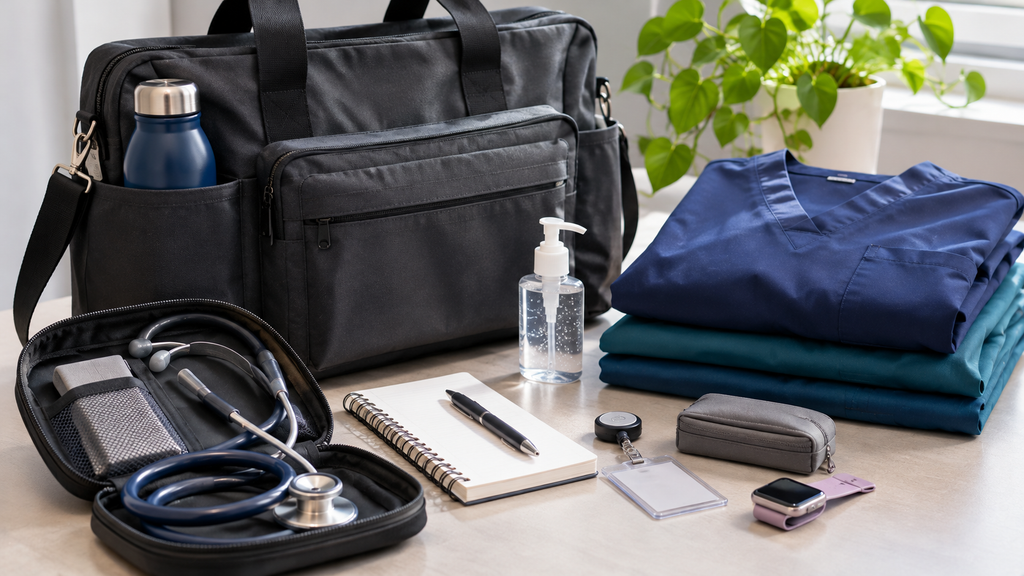
A dedicated nursing bag can provide additional organization for personal belongings and permitted work accessories.
This can also reduce the visual bulk created by heavily loaded pockets.
How Important Is a Stethoscope Case?
Professionals and students who regularly transport a stethoscope may benefit from dedicated storage.
A stethoscope case can provide a designated place for the instrument when traveling between home, school, and clinical environments.
A dedicated case can also help separate the stethoscope from other belongings inside a larger bag.
Should Healthcare Professionals Choose Men’s or Women’s Scrubs?
The most important consideration is fit rather than the label itself.
Different men’s and women’s garments can use different proportions around:
- Shoulders
- Chest
- Waist
- Hips
- Torso
- Inseam
Professionals should select the cut that best matches their body proportions and preferences.
A properly fitting garment can improve both comfort and appearance regardless of the category in which it is marketed.
How Should Scrub Pants Be Selected by Profession?
Scrub pants should be selected according to movement requirements and preferred fit.
Common options include:
- Joggers
- Straight-leg pants
- Tapered pants
- Flare pants
- Petite lengths
- Regular lengths
- Tall lengths
A nurse who spends much of the day walking may prefer a flexible tapered or jogger style.
A physician may prefer a traditional straight-leg silhouette.
A professional with longer or shorter legs may need a dedicated length rather than simply changing the overall size.
How Should Scrub Tops Be Selected?
Scrub tops can differ in:
- Neckline
- Sleeve length
- Pocket configuration
- Side vents
- Overall length
- Fit
- Fabric
A V-neck can provide a traditional appearance, while mock-wrap and other structured styles can create a different silhouette.
The most appropriate option depends on the role, workplace requirements, and personal preference.
How Important Are Scrub Jackets?
Scrub jackets can provide additional warmth and coverage without requiring a completely different uniform.
They can be particularly useful for professionals who move between areas with different temperatures.
When selecting a jacket, consider:
- Fit over the scrub top
- Fabric weight
- Stretch
- Sleeve length
- Closure
- Pockets
- Color
The jacket should complement the rest of the uniform without creating excessive bulk.
How Should Healthcare Professionals Choose Workwear by Environment?
Profession is only one part of the decision.
The physical environment also matters.
Hospitals
Hospital workers may need highly mobile uniforms suitable for long shifts and frequent movement.
Outpatient Clinics
Clinic professionals may place greater emphasis on a combination of comfort and polished appearance.
Dental Practices
Dental professionals may prioritize comfortable movement and easy-care garments.
Veterinary Clinics
Durability and mobility can become particularly important.
Educational Settings
Students should prioritize program-specific requirements.
How Should Climate Affect Healthcare Workwear?
Climate and indoor temperature can influence fabric and layering choices.
In warmer environments, professionals may prefer:
- Lightweight fabrics
- Breathable construction
- Shorter sleeves where permitted
- Flexible layers
In cooler environments, they may prefer:
- Long-sleeve underscrubs
- Lightweight scrub jackets
- Slightly heavier fabrics
Indoor climate can be just as important as outdoor weather because many healthcare professionals spend most of their shifts inside.
How Should Healthcare Professionals Build a Basic Wardrobe?
A basic wardrobe can be built in stages.
Step 1: Identify Requirements
Determine required colors, styles, and garments.
Step 2: Choose Core Sets
Purchase enough scrub sets for the normal schedule.
Step 3: Add Backup Sets
Keep additional uniforms available for unexpected situations.
Step 4: Add Layers
Choose appropriate jackets or underscrubs if needed.
Step 5: Add Accessories
Purchase only the bags, cases, and storage accessories required for the role.
This approach avoids building a large wardrobe before understanding which garments actually work.
How Many Healthcare Uniforms Should You Own?
There is no universal number.
A practical calculation is:
Regular workdays between laundry cycles + backup sets = approximate minimum wardrobe
For example, someone working five consecutive shifts and doing laundry once per week may need at least five usable sets plus additional backup options.
Other professionals may need fewer or more depending on their schedules.
How Can Healthcare Professionals Balance Comfort and Appearance?
A professional uniform does not need to be restrictive.
The most effective approach is to focus on:
- Appropriate fit
- Coordinated colors
- Suitable garment length
- Clean condition
- Functional pockets
- Appropriate layers
- Workplace-approved styles
A well-fitting scrub can be comfortable and polished at the same time.
What Are Common Healthcare Workwear Mistakes?
Choosing Appearance Over Function
A garment may look attractive but become uncomfortable during a long shift.
Ignoring Workplace Requirements
A preferred color or style may not be permitted.
Buying the Wrong Length
Inappropriate inseam can affect both comfort and appearance.
Overloading Pockets
Too much weight can make uniforms uncomfortable.
Buying Too Few Sets
Insufficient uniforms can make laundry management difficult.
Ignoring Fabric Care
Incorrect washing and drying can shorten garment life.
Buying Too Many Styles
A large collection is unnecessary if only a few garments are actually comfortable and useful.
Healthcare Workwear Checklist by Profession
| Profession | Key Workwear Priorities | Useful Accessories |
| Nurses | Mobility, comfort, storage, durability | Nursing bag, stethoscope case |
| Physicians | Professional appearance, comfort, layering | Work bag, stethoscope case |
| Medical assistants | Versatility, mobility, easy care | Small work bag |
| Dental professionals | Movement, coverage, easy care | Work organizer |
| Veterinary professionals | Durability, mobility, easy care | Work bag |
| Nursing students | Program compliance, comfort, backup sets | Nursing bag, stethoscope case |
| Medical students | Clinical requirements, versatility, comfort | Stethoscope case, backpack |
| Allied health | Mobility, role-specific functionality | Role-dependent storage |
How Can You Build a Profession-Specific Healthcare Wardrobe on a Budget?
Start with the items used most frequently.
Prioritize:
- Required scrub sets
- Appropriate fit
- Backup uniforms
- Necessary layers
- Essential accessories
- Additional styles only after the basics are covered
This approach helps avoid spending money on garments that look appealing but are rarely used.
A smaller collection of well-fitting uniforms can be more practical than a large collection of unsuitable garments.
Where Can Healthcare Professionals Find Workwear for Different Roles?
Healthcare professionals can begin by identifying the garment categories that match their work requirements.
A broad healthcare uniforms selection can provide options for different clinical roles and workplace environments.
Professionals who want to review a broader range of medical scrubs can evaluate different tops, pants, jackets, fits, and styles before choosing a workwear rotation.
Those who prefer to assess fit and fabric in person can visit a medical uniform retailer and evaluate available garments according to their professional needs.
Frequently Asked Questions
What type of workwear is best for healthcare professionals?
The best workwear depends on the profession, work environment, movement requirements, shift length, dress code, and personal preferences. Scrubs are common across many healthcare roles, but the ideal fit, fabric, style, and accessories can vary considerably.
Do nurses and physicians need the same type of scrubs?
Not necessarily. Nurses may prioritize mobility, storage, and long-shift comfort, while physicians may place greater emphasis on professional presentation, layering, and versatility. Individual workplace requirements should determine the final choice.
What should nursing students include in their workwear wardrobe?
Nursing students should start with the garments required by their school and clinical placements. A practical wardrobe may include several approved scrub sets, backup uniforms, permitted layers, a nursing bag, and a stethoscope case.
Are jogger scrubs appropriate for all healthcare professions?
Joggers can be suitable for many healthcare professionals, but workplace dress codes vary. The style should also provide sufficient room for movement and fit comfortably through the waist, hips, thighs, and lower leg.
How many scrub sets does a healthcare professional need?
The number depends on the work schedule and laundry frequency. A useful starting point is enough sets to cover the normal period between laundry cycles, plus at least one or two backup sets.
What accessories are useful with healthcare uniforms?
Accessories depend on the role. Nursing bags, medical backpacks, stethoscope cases, and work organizers can help store items that should not be carried in scrub pockets. Only accessories that are permitted and genuinely useful should be included.
Conclusion
Healthcare workwear should be selected according to the realities of the job rather than based solely on appearance or general fashion trends. Different professions create different demands, and the most useful uniform is one that supports those demands throughout the workday.
Nurses may need mobility, practical storage, durable fabrics, and long-shift comfort. Physicians may prioritize a combination of professional appearance, comfort, and versatile layering. Medical assistants may need garments that transition between clinical and administrative tasks, while dental and veterinary professionals may have their own requirements based on movement and work environment.
Students face another important consideration: compliance with school and clinical-site requirements. Before purchasing multiple sets, students should confirm approved colors, styles, accessories, and other uniform rules.
Fit remains important across every profession. Scrub tops should allow comfortable shoulder and torso movement, while pants should provide appropriate waist, hip, thigh, rise, and inseam proportions. Fabric selection also matters because stretch, breathability, durability, and care requirements can affect long-term comfort and maintenance.
Accessories can complete a practical workwear system. A nursing bag can provide additional storage, while a dedicated stethoscope case can keep frequently transported equipment organized. These items can also reduce the need to overload uniform pockets.
Ultimately, the best healthcare wardrobe is profession-specific, workplace-appropriate, comfortable, and practical. By considering the actual demands of the role before purchasing, healthcare professionals can build a smaller and more useful collection of uniforms that supports both daily performance and professional presentation.