
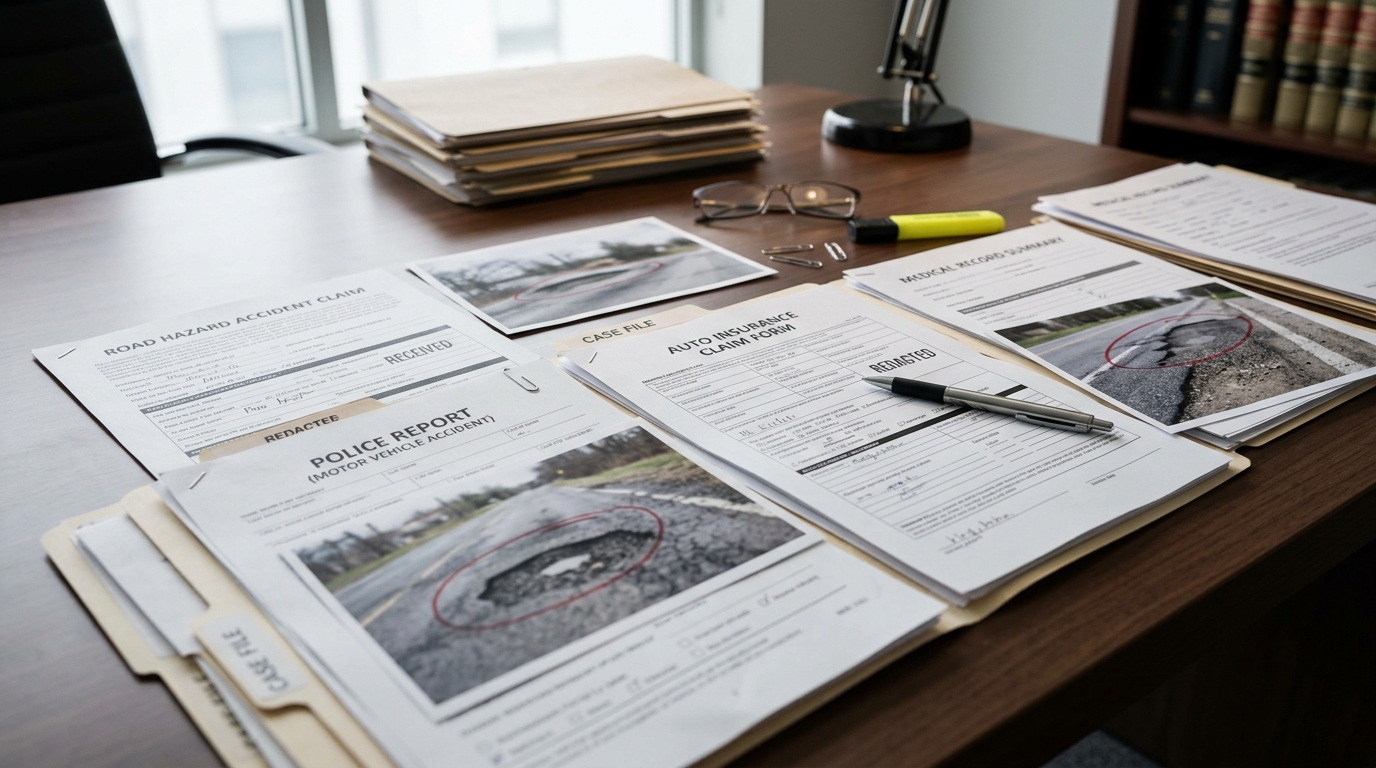
Road hazard and poor maintenance accident claims in New York can involve potholes, broken pavement, unsafe shoulders, missing signs, blocked sight lines, poor drainage, debris, defective traffic signals, construction hazards, and other dangerous roadway conditions. These claims often require fast evidence preservation because the hazard may be repaired, moved, cleaned up, or changed soon after the crash. A car accident attorney resource can help explain how liability, insurance coverage, medical evidence, and damages are generally evaluated after a roadway-related crash.
Quick Answer
A road hazard accident claim in New York usually depends on proving what dangerous condition caused the crash, who owned or controlled the roadway, whether that party had notice of the hazard, whether the hazard should have been repaired or warned about, and how the condition caused the injuries. Important evidence may include photos, videos, measurements, police reports, maintenance records, prior complaints, witness statements, dashcam footage, medical records, no-fault documents, insurance letters, and deadline-sensitive notice documents.
Key Takeaways
- Road hazard claims may involve public roads, private roads, parking lots, construction zones, utility work, commercial properties, or government-maintained areas.
- Dangerous road conditions may include potholes, broken pavement, shoulder drop-offs, loose gravel, debris, poor drainage, missing signs, blocked signs, defective traffic signals, and unsafe construction zones.
- New York DMV’s MV-104 form states that crashes involving injury, death, or more than $1,000 in property damage to any one person must be reported within 10 days. New York DMV MV-104
- New York no-fault written notice generally must be submitted as soon as reasonably practicable, but no more than 30 days after the accident unless there is a clear and reasonable justification for late filing. New York DFS
- Claims against public entities may require a notice of claim within 90 days when General Municipal Law § 50-e applies. New York General Municipal Law § 50-e
- Comparative fault can still be argued if the injured person is accused of driving too fast, failing to avoid the hazard, following too closely, or ignoring road conditions. New York CPLR § 1411
- Identifying the correct responsible party is often one of the hardest parts of a road hazard claim.
What Is a Road Hazard Accident Claim?
A road hazard accident claim may arise when a dangerous roadway condition causes or contributes to a crash. The hazard may be on a public road, private road, parking lot, bridge, shoulder, construction area, driveway, ramp, intersection, or commercial property.
Road hazard claims may involve:
- Potholes
- Cracked pavement
- Uneven road surfaces
- Shoulder drop-offs
- Missing lane markings
- Loose gravel
- Road debris
- Fallen objects
- Poor drainage
- Standing water
- Ice or snow accumulation
- Defective guardrails
- Missing signs
- Blocked signs
- Malfunctioning traffic signals
- Unsafe construction zones
- Utility cuts or trench patches
- Defective manhole covers
- Poor lighting
- Unsafe parking lot surfaces
The claim usually depends on connecting the condition to the crash and identifying who was responsible for inspection, maintenance, repair, warning, or traffic control.
Why Road Hazard Claims Are Often Complicated
Road hazard claims can be more complicated than ordinary two-driver crashes because the responsible party may not be immediately obvious. A dangerous condition may involve a city, town, village, county, state agency, contractor, utility company, property owner, commercial tenant, snow removal company, or another private party.
These claims may become complicated because:
- The hazard may be repaired quickly.
- The road owner may not be clear.
- Several entities may share maintenance responsibility.
- A public entity notice deadline may apply.
- Prior written notice rules may be raised.
- Weather may affect the analysis.
- Multiple drivers may be involved.
- Insurance companies may blame driver conduct.
- The defect may need measurement.
- Photos may not show depth or height clearly.
- Maintenance records may need to be requested.
- Prior complaints may be hard to locate.
- Construction or utility work may involve several contractors.
A broader guide to New York road accident liability can help explain why ownership, control, notice, and roadway evidence often matter after a crash.
Common Road Hazards That Cause Accidents
Road hazards can affect cars, trucks, motorcycles, bicycles, pedestrians, and passengers. Some hazards cause direct crashes, while others cause a driver to swerve, brake suddenly, lose control, or collide with another vehicle.
Common hazards include:
- Deep potholes
- Uneven pavement transitions
- Raised utility covers
- Loose manhole covers
- Roadway depressions
- Broken asphalt
- Missing shoulder protection
- Unsafe pavement edges
- Washed-out roads
- Poor drainage
- Standing water
- Black ice
- Accumulated snow
- Fallen tree limbs
- Cargo debris
- Construction materials
- Missing barricades
- Inadequate warning signs
- Faded lane markings
- Malfunctioning traffic lights
- Poorly placed cones
- Unmarked road work
- Obstructed stop signs
A hazard does not automatically create liability. The claim usually needs evidence showing that the condition was dangerous, that a responsible party had notice or should have acted, and that the hazard caused the crash.
Poor Road Maintenance and Liability
Poor maintenance may involve failing to repair known hazards, delaying needed road work, ignoring complaints, using temporary repairs that quickly fail, failing to inspect, or failing to warn drivers about a dangerous condition.
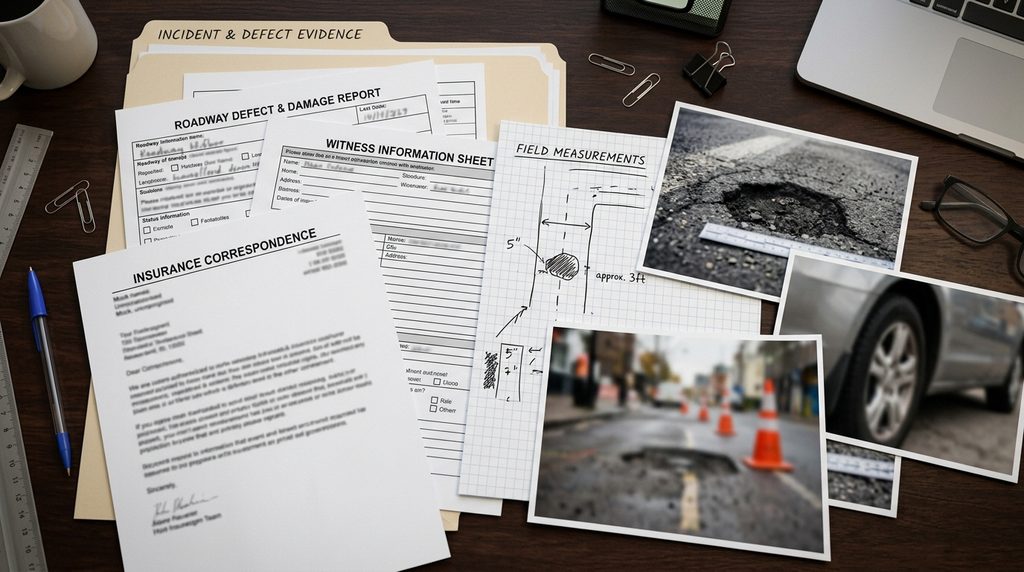
Poor maintenance issues may include:
- Repeated pothole repairs that fail
- Poorly patched utility cuts
- Road surfaces left uneven after construction
- Inadequate drainage maintenance
- Failure to remove debris
- Failure to replace missing signs
- Failure to repaint lane markings
- Failure to repair traffic signal problems
- Failure to maintain shoulders
- Failure to inspect known trouble spots
- Failure to place temporary warnings
The key question is usually not only whether the road was unsafe. The claim must also identify who had responsibility for the condition and whether the evidence supports liability.
Who May Be Responsible for a Road Hazard Accident?
Responsibility depends on ownership, control, maintenance duties, contracts, work permits, and the facts of the crash. A road hazard claim should not assume that the first identified party is the only possible responsible party.
Potentially responsible parties may include:
- City agencies
- Town governments
- Village governments
- County agencies
- New York State agencies
- Public authorities
- Private property owners
- Commercial property owners
- Parking lot owners
- Property managers
- Road construction contractors
- Utility companies
- Snow and ice contractors
- Landscaping companies
- Trucking companies that dropped debris
- Businesses that created or failed to correct hazards
- Maintenance vendors
- Event organizers, in limited situations
A complete claim review should identify who owned the location, who controlled the area, who performed work there, who received complaints, and who had authority to fix or warn about the hazard.
Public Road vs. Private Property Claims
Road hazard claims can follow different paths depending on whether the accident happened on a public road or private property.
Public road claims may involve:
- Municipal notice of claim rules
- Prior written notice arguments
- Highway maintenance records
- DOT or local agency records
- Road work permits
- Snow and ice procedures
- Traffic signal maintenance
- Public entity immunity arguments
- Shorter deadlines
Private property claims may involve:
- Premises liability
- Property owner control
- Lease agreements
- Parking lot maintenance
- Snow removal contracts
- Commercial inspection logs
- Prior complaints
- Surveillance footage
- Vendor responsibility
A premises liability attorney resource may help explain why property control, inspection history, maintenance records, and notice can matter when a roadway hazard exists on private property or a commercial premises.
Claims Involving Municipal Roads
Many road hazard claims involve municipalities because local governments often maintain roads, sidewalks, intersections, traffic signs, drainage systems, or public parking areas. These claims can be deadline-sensitive and technically demanding.
Municipal road hazard claims may involve:
- Potholes
- Broken pavement
- Missing signs
- Defective traffic signals
- Unsafe intersections
- Poor road drainage
- Snow and ice conditions
- Sidewalk-adjacent roadway defects
- Crosswalk problems
- Guardrail conditions
- Construction-zone warnings
- Roadway design issues
When a public corporation is involved, General Municipal Law § 50-e may require a notice of claim within 90 days, depending on the claim type and entity involved. New York General Municipal Law § 50-e
Prior Written Notice Issues
Some road defect claims against municipalities involve prior written notice rules. These rules may require proof that the municipality had written notice of the specific defect before the accident. The details can depend on the municipality, statute, local law, defect type, and case facts.
Prior written notice issues may involve:
- Whether the defect was reported before the crash
- Whether the report was written
- Whether the report identified the correct location
- Whether the report was sent to the correct office
- Whether the defect was the same condition that caused the accident
- Whether a repair was attempted
- Whether an exception may apply
- Whether the municipality created or worsened the hazard
- Whether a special use issue exists
General Municipal Law § 50-g addresses recording notices of defects in certain circumstances. New York General Municipal Law § 50-g
County Road and Highway Issues
County road claims may involve special rules and maintenance responsibilities. Highway Law § 139 addresses county liability for injuries caused by defective highways and bridges when the county has charge of repair or maintenance, subject to the statute’s requirements. New York Highway Law § 139
County roadway claims may involve:
- County road maintenance records
- Prior complaints
- Pothole repair records
- Drainage records
- Bridge or culvert conditions
- Shoulder maintenance
- Snow and ice response
- Work order history
- Inspection logs
- Roadway design records
- Contractor involvement
The proper defendant should be identified carefully because road ownership and road maintenance responsibility are not always the same.
State Road and Highway Claims
Some crashes involve state highways, parkways, ramps, bridges, or roads maintained by New York State or a state authority. These claims may involve different procedures from claims against a town, village, city, or county.
State-related roadway issues may include:
- Highway surface defects
- Unsafe shoulders
- Bridge conditions
- Ramp hazards
- Guardrail conditions
- Drainage failures
- Work zone conditions
- Traffic signal maintenance
- Snow and ice response
- State contractor work
- Road design claims
A state road accident claim may require review of maintenance responsibility, agency records, public authority involvement, contractor records, and filing rules that differ from local municipal claims.
Construction Zone Road Hazards
Construction zones can create serious roadway hazards when traffic patterns change, lanes narrow, pavement becomes uneven, or warning signs are missing. A construction-related road hazard may involve public agencies, contractors, subcontractors, traffic control companies, utility companies, or property owners.
Construction zone hazards may include:
- Uneven pavement
- Temporary lane shifts
- Loose gravel
- Unmarked trenches
- Exposed plates
- Poorly placed cones
- Missing flaggers
- Defective barricades
- Inadequate warning signs
- Sudden lane closures
- Poor lighting
- Confusing detours
- Equipment left near traffic
- Debris in the roadway
A construction accident attorney resource may help readers understand why contractor records, safety plans, work permits, and site-control evidence may matter when construction work contributes to an injury.
Utility Work and Road Cuts
Utility work can create hazards when trenches, patches, plates, or repair areas are not properly maintained. A road may look normal from a distance but create a sudden jolt, skid, or loss of control when a vehicle reaches the defect.
Utility-related hazards may involve:
- Utility cuts
- Sunken trench patches
- Raised steel plates
- Loose plates
- Unmarked work areas
- Debris from repair work
- Poorly restored pavement
- Unfinished roadwork
- Missing warnings
- Temporary repairs that failed
Claims involving utility work may require identifying the utility company, contractor, permit holder, maintenance responsibility, and inspection history.
Pothole Accident Claims
Potholes can cause vehicle damage, loss of control, motorcycle crashes, bicycle crashes, pedestrian injuries, and secondary collisions. A pothole claim usually requires evidence about the pothole’s size, location, age, visibility, and maintenance history.
Useful pothole evidence may include:
- Photos with scale or measurement
- Video of the hazard
- Exact location
- Lane position
- Date and time
- Weather conditions
- Prior complaint records
- Repair records
- Witness statements
- Vehicle damage photos
- Tire and wheel damage
- Dashcam footage
- Medical records
- Police report
A pothole that appears minor in a photo may be much deeper in person, so measurement and scale can be important.
Debris and Fallen Object Claims
Road debris can cause crashes when drivers strike objects, swerve to avoid them, or lose control. Debris may come from a truck, construction site, landscaping vehicle, public cleanup failure, storm damage, or another driver.
Road debris claims may involve:
- Unsecured cargo
- Construction materials
- Tire debris
- Fallen ladders
- Tree limbs
- Trash or containers
- Gravel spills
- Metal objects
- Vehicle parts
- Storm debris
- Work zone materials
- Objects from a nearby property
If the debris came from a vehicle, a trucking company, contractor, delivery company, or private driver may need to be investigated.
Poor Drainage, Standing Water, and Ice
Poor drainage can create standing water, hydroplaning risk, icy patches, erosion, and pavement failure. These claims may involve road design, drain maintenance, clogged catch basins, snowmelt, weather, or inadequate repairs.
Drainage-related hazards may include:
- Standing water
- Flooded lanes
- Hydroplaning
- Ice patches
- Clogged drains
- Washed-out shoulders
- Erosion near the road edge
- Mud or sediment on the roadway
- Water pooling near intersections
- Ice forming from recurring runoff
Weather alone may not prove liability. The claim may need evidence showing that a dangerous drainage condition existed, that the responsible party had notice, and that the condition caused the crash.
Missing or Defective Signs and Signals
Traffic control problems can cause crashes when drivers do not receive proper warnings, direction, or right-of-way information. These claims may involve missing stop signs, blocked signs, faded lane markings, broken traffic lights, malfunctioning signals, or confusing detours.
Sign and signal issues may include:
- Missing stop signs
- Blocked stop signs
- Faded lane markings
- Missing curve warnings
- Missing construction warnings
- Malfunctioning traffic lights
- Conflicting signal indications
- Poor signal visibility
- Inadequate pedestrian signals
- Missing merge warnings
- Defective detour signs
These claims may require photos, maintenance records, complaint history, signal timing records, work orders, and witness statements.
Road Hazards and Motorcycle Accidents
Motorcyclists are especially vulnerable to road hazards because potholes, gravel, debris, uneven pavement, metal plates, and shoulder drop-offs can cause loss of control more easily than they might for a car.
Motorcycle road hazard evidence may include:
- Hazard photos with measurements
- Motorcycle damage photos
- Helmet photos
- Clothing damage
- Scene photos
- Witness statements
- Dashcam or helmet camera footage
- Police report
- Road surface details
- Medical records
- Maintenance records
- Weather conditions
A motorcycle accident attorney resource may help explain why roadway surface, visibility, driver conduct, and injury evidence often matter in motorcycle claims.
Road Hazards and Bicycle Accidents
Bicyclists may be seriously injured by potholes, drainage grates, uneven pavement, debris, construction plates, missing bike lane markings, or road edge defects. A condition that a car might pass over safely can be dangerous for a bicycle.
Bicycle road hazard evidence may include:
- Photos of the defect
- Measurements
- Bicycle damage
- Helmet damage
- Lighting and visibility evidence
- Bike lane markings
- Witness statements
- Nearby camera footage
- Medical records
- Complaint history
- Maintenance records
- Road ownership information
A bicycle accident attorney resource may help explain why road conditions, vehicle interactions, and medical documentation often matter after a bike crash.
Road Hazards and Pedestrian Injuries
Road hazards may also injure pedestrians, especially near crosswalks, curb ramps, sidewalks, parking lots, driveway aprons, bus stops, and poorly maintained shoulders.
Pedestrian-related hazards may include:
- Broken crosswalk surfaces
- Defective curb ramps
- Poor drainage at crossings
- Missing pedestrian signals
- Broken pavement near bus stops
- Unsafe parking lot transitions
- Loose gravel
- Snow or ice buildup
- Poor lighting
- Debris near walking areas
A pedestrian road hazard claim may overlap with premises liability, municipal notice rules, traffic control issues, and roadway maintenance responsibilities.
Road Hazards and Truck or Commercial Vehicle Crashes
Road hazards involving trucks may be especially serious because large vehicles require more stopping distance and may react differently to debris, pavement defects, or sudden lane changes. Commercial vehicles may also create hazards if cargo falls into the road.
Truck-related road hazard issues may include:
- Unsecured cargo
- Tire blowouts
- Road debris
- Improper loading
- Construction zone hazards
- Poor route planning
- Sudden braking near road defects
- Failure to adjust speed to conditions
- Maintenance-related vehicle failures
- Commercial insurance coverage
A truck accident attorney resource may help explain why commercial vehicle records, cargo evidence, insurance coverage, and roadway conditions may all need review.
Road Hazards and Multi-Vehicle Accidents
A road hazard may trigger a multi-vehicle crash when one driver swerves, brakes suddenly, loses control, or collides with another vehicle. In those cases, the claim may involve both the hazard and driver conduct.
Multi-vehicle road hazard questions may include:
- Which driver encountered the hazard first?
- Did one driver brake suddenly?
- Was following distance reasonable?
- Did another driver swerve into traffic?
- Was the hazard visible?
- Were warning signs present?
- Did weather affect stopping distance?
- Did a contractor create the hazard?
- Did debris fall from another vehicle?
- Were multiple insurers involved?
New York Vehicle and Traffic Law § 1180 requires drivers to operate at a speed that is reasonable and prudent under conditions and actual or potential hazards. New York Vehicle and Traffic Law § 1180
No-Fault Benefits After a Road Hazard Crash
New York no-fault benefits may apply after many motor vehicle accidents, even when the crash was caused by a road condition rather than another driver. No-fault benefits may help pay certain economic losses.
No-fault benefits may cover:
- Emergency treatment
- Hospital bills
- Doctor visits
- Diagnostic testing
- Physical therapy
- Chiropractic care
- Prescription medication
- Lost earnings
- Transportation to medical care
- Certain reasonable and necessary expenses
New York DFS explains that written no-fault notice must generally be submitted as soon as reasonably practicable, but no more than 30 days after the accident unless there is a clear and reasonable justification for late notice. New York DFS
A broader guide to the New York no-fault insurance system can help explain how first-party benefits, medical bill submissions, wage claims, and insurance timing may work after a crash.
Pain and Suffering After a Road Hazard Accident
No-fault benefits generally do not pay pain and suffering. In many New York motor vehicle claims, a person seeking pain and suffering damages must prove a serious injury under New York Insurance Law.
Insurance Law § 5102 defines serious injury categories, including death, dismemberment, significant disfigurement, fracture, loss of fetus, permanent loss of use, permanent consequential limitation, significant limitation, and certain 90/180-day impairments. New York Insurance Law § 5102
Serious injury evidence may include:
- Fracture records
- MRI reports
- CT scans
- Surgical records
- Specialist reports
- Range-of-motion findings
- Physical therapy notes
- Permanent limitation opinions
- Work restriction notes
- Disability records
- Scarring photos
- Future care recommendations
Road hazard evidence may help prove fault, but medical records are still needed to prove injuries and damages.
Evidence Needed in a Road Hazard Claim
Road hazard claims are evidence-sensitive because the condition may change quickly. A pothole may be patched, debris may be removed, a sign may be replaced, or construction equipment may be moved before the claim is fully investigated.
Important evidence may include:
- Police report
- DMV MV-104 report
- Photos of the hazard
- Videos of the hazard
- Measurements of the defect
- Photos showing scale
- Exact location
- GPS coordinates, when available
- Weather conditions
- Lighting conditions
- Dashcam footage
- Nearby surveillance footage
- Witness statements
- Prior complaints
- 311 or agency reports
- Maintenance records
- Work orders
- Construction permits
- Utility permits
- Road repair records
- Medical records
- Medical bills
- Lost wage documents
- Insurance letters
A broader guide to evidence for personal injury claims can help explain why reports, photos, records, witness information, and medical documentation often need to support the same timeline.
Photos, Measurements, and Location Details
Photos are useful, but they should show the hazard clearly. A close-up photo may show the defect, while a wider photo may show where it was located in relation to the lane, shoulder, intersection, crosswalk, or parking lot.
Helpful documentation may include:
- Close-up photos
- Wide-angle photos
- Photos with a ruler, tape measure, or common object for scale
- Photos from the driver’s approach direction
- Photos of warning signs or missing warnings
- Photos of skid marks or debris
- Photos of vehicle damage
- Photos of traffic controls
- GPS location
- Nearest address
- Nearest intersection
- Lane position
- Time and date
The goal is to make the condition understandable even after it has changed.
Police Reports and DMV Reports
Police reports can help document the crash date, location, drivers, injuries, property damage, roadway condition, witnesses, and apparent contributing factors. They may also note a pothole, debris, weather, construction zone, or other road condition.
New York DMV’s MV-104 form states that a crash occurring in New York State must be reported within 10 days when it causes a fatality, personal injury, or more than $1,000 in damage to the property of any one person. New York DMV MV-104
Useful report details may include:
- Crash location
- Road condition
- Weather condition
- Lighting condition
- Driver statements
- Witness information
- Injury notation
- Vehicle damage
- Roadway defect description
- Diagram
- Apparent contributing factors
- Ticket information, when applicable
If the report does not mention the hazard, other evidence may still be used.
Maintenance Records and Prior Complaints
Maintenance records and prior complaints can be important because many road hazard claims depend on notice. A responsible party may argue that it did not know about the hazard before the accident.

Useful records may include:
- Work orders
- Complaint logs
- Inspection records
- Repair history
- Pothole reports
- 311 reports
- DOT records
- Maintenance schedules
- Contractor logs
- Utility permits
- Road opening permits
- Construction records
- Snow and ice logs
- Drainage maintenance records
- Traffic signal repair records
These records may show whether the hazard was known, recurring, recently repaired, or ignored.
Witness Statements
Witnesses can help confirm the condition existed, describe how long it had been present, explain how the crash happened, or identify whether other people had previously complained.
Witnesses may include:
- Drivers
- Passengers
- Pedestrians
- Bicyclists
- Motorcyclists
- Nearby residents
- Business owners
- Store employees
- Construction workers
- Utility workers
- Police officers
- Emergency responders
- Tow truck drivers
Witness information should include names, phone numbers, emails, what they saw, and whether they have photos or video.
Video Evidence and Dashcam Footage
Video can be very helpful in road hazard cases. It may show the condition before the crash, the driver’s approach, the impact, vehicle movement, traffic conditions, or whether warnings were present.
Potential video sources include:
- Dashcams
- Helmet cameras
- Traffic cameras
- Business surveillance cameras
- Gas station cameras
- Parking lot cameras
- Doorbell cameras
- Construction site cameras
- Truck cameras
- Bus cameras
- Rideshare vehicle cameras
- Nearby building cameras
Video may be overwritten quickly. Preservation requests should be made early.
Accident Reconstruction and Expert Review
Some road hazard claims require expert review because the cause of the crash is disputed. An accident reconstruction expert, engineer, roadway safety expert, or maintenance expert may help explain how the hazard affected vehicle movement or driver response.
Expert review may address:
- Vehicle speed
- Driver reaction time
- Visibility
- Braking distance
- Impact angle
- Pavement condition
- Roadway design
- Drainage
- Signage
- Traffic control
- Construction zone layout
- Hazard measurements
- Whether warnings were adequate
- Whether a repair was reasonable
- Whether the hazard caused the crash
Expert review is not required in every case, but it may be useful when the crash involves serious injuries, disputed fault, or a changed roadway condition.
Medical Records and Injury Documentation
Medical records help show what injuries were caused by the crash and how the injuries affected the person’s life. Road hazard crashes can produce sudden impacts, loss of control, rollovers, motorcycle ejections, bicycle falls, pedestrian falls, and multi-vehicle collisions.
Important medical records may include:
- Ambulance records
- Emergency room records
- Hospital records
- Urgent care records
- Primary care records
- Orthopedic records
- Neurology records
- Imaging reports
- Physical therapy notes
- Chiropractic records
- Pain management records
- Surgical records
- Work restriction notes
- Future care recommendations
Medical records are especially important when the defense argues that the hazard caused vehicle damage but not serious injury.
Comparative Fault in Road Hazard Claims
Comparative fault can be raised when a driver is accused of failing to adjust to conditions or failing to avoid a visible hazard. New York CPLR § 1411 generally provides that damages may be reduced in proportion to the claimant’s share of fault, subject to specific rules. New York CPLR § 1411
Comparative fault arguments may involve:
- Driving too fast for conditions
- Following too closely
- Distracted driving
- Failing to keep a proper lookout
- Ignoring warning signs
- Swerving unsafely
- Braking suddenly
- Driving in a closed lane
- Failing to use headlights
- Riding a motorcycle or bicycle too fast for conditions
- Not avoiding a visible pothole or debris field
A strong claim should address why the hazard was unsafe and why the injured person’s response was reasonable under the circumstances.
Insurance Issues After a Road Hazard Accident
Road hazard claims may involve several insurance sources. The available coverage depends on who caused or controlled the hazard, whether another driver was involved, and whether the claim involves public or private property.
Insurance issues may include:
- No-fault benefits
- Bodily injury liability coverage
- Property damage coverage
- Commercial general liability coverage
- Contractor insurance
- Utility company insurance
- Municipal liability coverage
- Public authority coverage
- SUM coverage
- Uninsured motorist coverage
- Collision coverage
- Health insurance coordination
- Medical liens
- Policy limits
If the crash involved a roadway defect and another driver, both the road hazard and driver conduct may need review.
Property Damage and Vehicle Repair Claims
Road hazards often cause vehicle damage before or during the crash. Property damage evidence may help show the severity and nature of the hazard.
Property damage evidence may include:
- Tire damage
- Wheel damage
- Suspension damage
- Undercarriage damage
- Bumper damage
- Broken lights
- Airbag deployment
- Motorcycle damage
- Bicycle damage
- Repair estimates
- Total loss documents
- Towing records
- Storage bills
- Photos before repair
- Insurance letters
Property damage does not replace injury evidence, but it can help show the hazard’s impact.
Settlement Value in Road Hazard Accident Claims
Settlement value depends on liability, notice evidence, hazard severity, injury severity, medical treatment, future care, lost income, comparative fault, insurance coverage, and litigation risk.
Settlement factors may include:
- Hazard type
- Hazard size
- Hazard location
- Visibility
- Prior complaints
- Repair history
- Whether warning signs existed
- Whether a public entity is involved
- Whether notice of claim rules apply
- Medical diagnosis
- Surgery or injections
- Treatment duration
- Work restrictions
- Lost wages
- Future care needs
- Pain and suffering
- Insurance policy limits
- Comparative fault
Publicly available personal injury case results may provide general context, but every claim depends on its own facts, evidence, injuries, insurance coverage, and applicable law.
Common Defense Arguments in Road Hazard Claims
Road hazard claims often face specific defenses. A responsible party may argue that the condition was not dangerous, that it had no notice, that the driver caused the crash, or that the injury was unrelated.
Common arguments include:
- The hazard was minor.
- The hazard was open and obvious.
- The driver should have avoided it.
- The driver was speeding.
- Weather caused the crash.
- No prior written notice existed.
- The condition was repaired before the claim.
- Another party controlled the area.
- A contractor, not the owner, caused the hazard.
- The crash was caused by another driver.
- The injuries were pre-existing.
- Medical treatment was delayed.
- The condition did not cause the injury.
- The claim was filed too late.
A strong claim should be built around evidence that answers these arguments directly.
Public Entity Notice and Filing Deadlines
Deadlines can be especially important when a road hazard claim involves a city, town, village, county, public authority, school district, or other public corporation. General Municipal Law § 50-e may require a notice of claim within 90 days in covered cases. New York General Municipal Law § 50-e
General Municipal Law § 50-i addresses certain lawsuit timing requirements involving tort claims against a city, county, town, village, fire district, or school district, including a one-year-and-90-day period in covered circumstances. New York General Municipal Law § 50-i
These deadlines can be shorter than the general personal injury deadline. The correct deadline depends on the responsible entity, claim type, location, and applicable law.

Practical Road Hazard Claim Review Chart
| Claim Issue | Why It Matters | Useful Evidence |
| Hazard type | Shows what condition caused the crash | Photos, video, measurements |
| Location control | Identifies who may be responsible | Ownership records, agency records, contracts |
| Notice | Shows whether the responsible party knew or should have known | Complaints, work orders, inspection logs |
| Repair history | May show recurring problems or delayed repairs | Maintenance records, contractor files |
| No-fault benefits | Helps cover certain economic losses | No-fault forms, medical bills, wage records |
| Serious injury | May support pain and suffering recovery | Imaging, surgery notes, permanency opinions |
| Comparative fault | May reduce damages if fault is shared | Photos, video, speed evidence, witness statements |
| Public entity deadline | May control notice and filing timing | Notice of claim records, entity identification |
Common Mistakes After a Road Hazard Accident
Some mistakes can make a valid claim harder to prove.
Common mistakes include:
- Not photographing the hazard
- Not measuring the defect
- Not documenting the exact location
- Waiting too long to report the crash
- Not identifying witnesses
- Not checking for cameras
- Not preserving dashcam footage
- Not seeking timely medical care
- Missing no-fault notice deadlines
- Missing public entity notice deadlines
- Repairing the vehicle before photographing damage
- Assuming the road owner is obvious
- Not checking whether a contractor or utility company was involved
- Giving inconsistent statements to insurers
- Accepting an early settlement before medical treatment is clear
- Posting about the crash on social media
The strongest claims usually start with fast documentation and careful identification of the responsible party.
How to Organize a Road Hazard Claim File
A well-organized file can help show the hazard, crash sequence, medical treatment, and insurance issues.
Useful folders may include:
- Police report
- DMV MV-104 report
- Hazard photos
- Hazard measurements
- Scene videos
- Exact location notes
- Weather information
- Witness information
- Dashcam footage
- Surveillance footage requests
- Prior complaint records
- Maintenance records
- Construction or utility records
- Medical records
- Medical bills
- Imaging reports
- Work restriction notes
- Wage loss documents
- No-fault forms
- Insurance correspondence
- Repair estimates
- Policy documents
- Settlement offers
- Lien letters
Documents should be organized by date so the road condition, crash, medical treatment, and insurance timeline are clear.
Deadlines Still Matter
Road hazard accident claims may involve several deadlines at once. These may include DMV crash reporting, no-fault notice, medical bill submissions, lost wage proof, public entity notice of claim, policy notice, and lawsuit deadlines.
Important timing issues may include:
- MV-104 crash report timing
- No-fault written notice timing
- Medical bill submission timing
- Lost wage documentation
- Public entity notice of claim
- Municipal lawsuit timing
- Insurance policy notice
- SUM notice, if another driver was involved
- MVAIC deadlines, if an uninsured or unidentified vehicle was involved
- Discovery deadlines
- Settlement release timing
New York Courts lists three years for car accident claims and many negligence-based personal injury claims, but shorter insurance, no-fault, municipal, public authority, or policy notice deadlines may apply depending on the facts. New York Courts
When Legal Guidance May Be Useful
Legal guidance may be useful when a road hazard caused serious injuries, the hazard was repaired quickly, the road owner is unclear, a public entity may be responsible, prior written notice may be disputed, contractors or utility companies were involved, no-fault benefits are denied, another driver was also involved, or an early settlement offer arrives before the full medical outcome is known.
A road hazard accident claim review may require police reports, hazard photos, measurements, witness statements, maintenance records, prior complaints, agency records, construction permits, utility records, medical records, no-fault documents, insurance letters, vehicle repair records, wage records, and deadline tracking.
People researching local support may review a Farmingdale personal injury office when looking for Long Island motor vehicle accident claim information.
FAQs About Road Hazard Accident Claims in New York
Can someone file an injury claim after a crash caused by a pothole?
Possibly. A pothole injury claim may depend on who controlled the roadway, whether that party had notice of the condition, whether the pothole was dangerous, whether the driver acted reasonably, and whether medical records connect the injury to the crash.
Who is responsible for a road hazard accident in New York?
Responsibility may fall on a city, town, village, county, state agency, public authority, private property owner, contractor, utility company, snow removal company, or another party depending on ownership, control, maintenance duties, and how the hazard was created.
What evidence is important in a road hazard accident claim?
Important evidence may include photos, measurements, videos, exact location details, police reports, DMV reports, witness statements, prior complaints, maintenance records, repair history, construction records, medical records, no-fault forms, and insurance letters.
Does no-fault insurance apply after a road hazard crash?
No-fault benefits may apply after many New York motor vehicle accidents, even when a road condition contributed to the crash. Written no-fault notice generally must be submitted no more than 30 days after the accident unless there is a clear and reasonable justification for late notice.
Are road hazard claims against municipalities deadline-sensitive?
Yes. Claims involving municipalities or public entities may require a notice of claim within 90 days when General Municipal Law § 50-e applies. Other lawsuit timing rules may also apply, so these claims should be reviewed quickly.
Final Thoughts
Road hazard and poor maintenance accident claims in New York require careful investigation because the dangerous condition may change quickly and the responsible party may not be obvious. A strong claim usually depends on early photos, measurements, video preservation, police reports, maintenance records, prior complaints, medical documentation, no-fault paperwork, insurance review, and deadline tracking. The key issues are what hazard caused the crash, who controlled or maintained the area, whether notice can be proven, and how the injuries affected the person’s health, work, and daily life.