
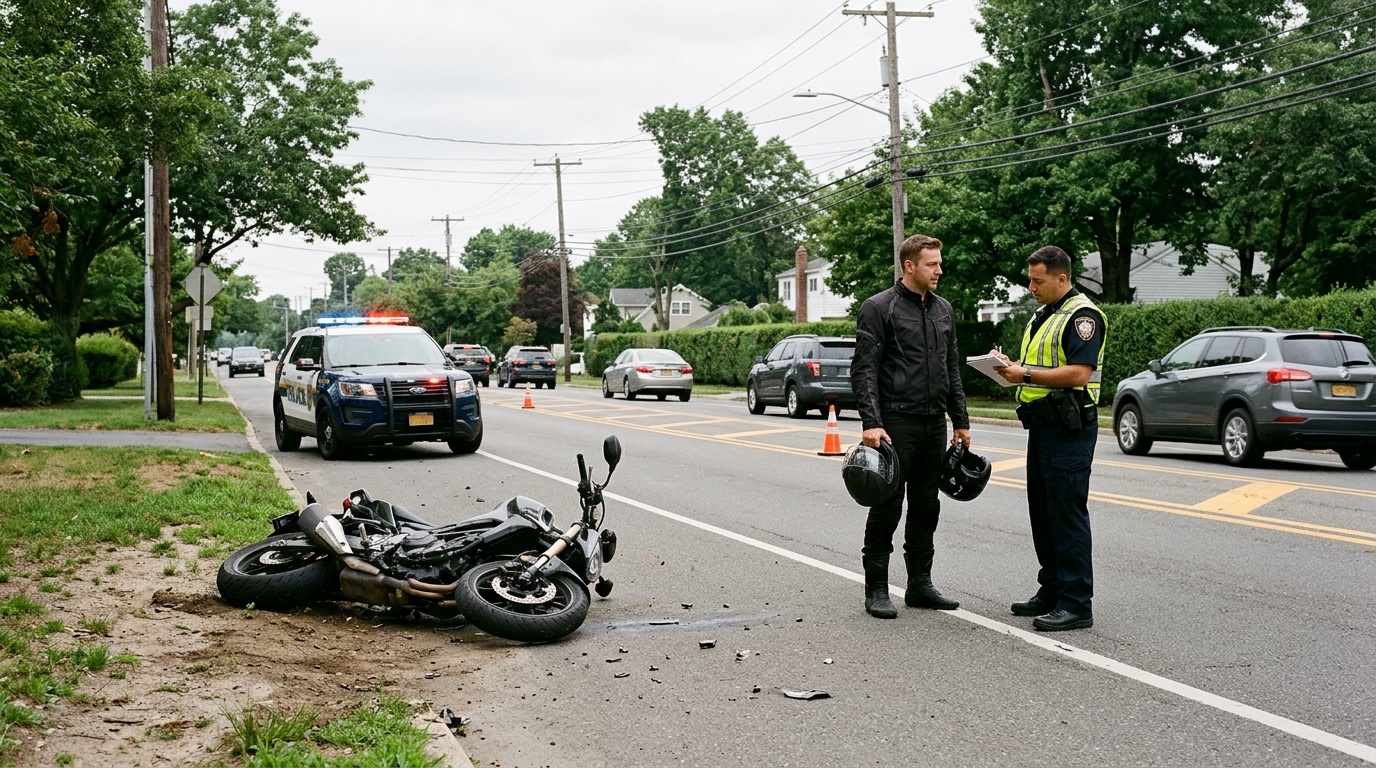
After a motorcycle accident on Long Island, riders should prioritize emergency medical care, report the collision, preserve evidence, exchange information, and document their injuries. These actions can protect personal safety and help establish the facts needed for an insurance claim or personal injury lawsuit.
Motorcycle crashes often involve serious injuries, disputed liability, and insurance rules that differ from those applying to ordinary passenger vehicles. Understanding the appropriate steps after a collision can help injured riders avoid preventable complications and protect their legal rights.
Quick Answer: What Should You Do After a Motorcycle Accident?
After a motorcycle crash on Long Island, the most important steps are:
- Get to Safety: Avoid additional traffic hazards and call 911 when emergency assistance is needed.
- Seek Medical Attention: Have injuries evaluated, even when symptoms initially seem manageable.
- Report the Crash: Notify law enforcement and complete applicable New York DMV reporting requirements.
- Preserve Evidence: Photograph vehicles, roadway conditions, damaged equipment, and visible injuries when safe.
- Collect Information: Obtain driver, witness, vehicle, and insurance details.
- Notify Your Insurer: Report the collision according to applicable policy requirements.
- Maintain Records: Keep medical documents, receipts, employment records, and correspondence.
- Understand Your Rights: Identify potential liability, available coverage, and relevant legal deadlines.
The order of these actions depends on the severity of the crash. Emergency treatment and personal safety always take priority over evidence collection.
What Should Riders Do Immediately After a Motorcycle Crash?
The first few minutes after a motorcycle collision can be confusing. Riders may experience pain, disorientation, or shock, particularly when the crash involves direct impact with another vehicle or the roadway.
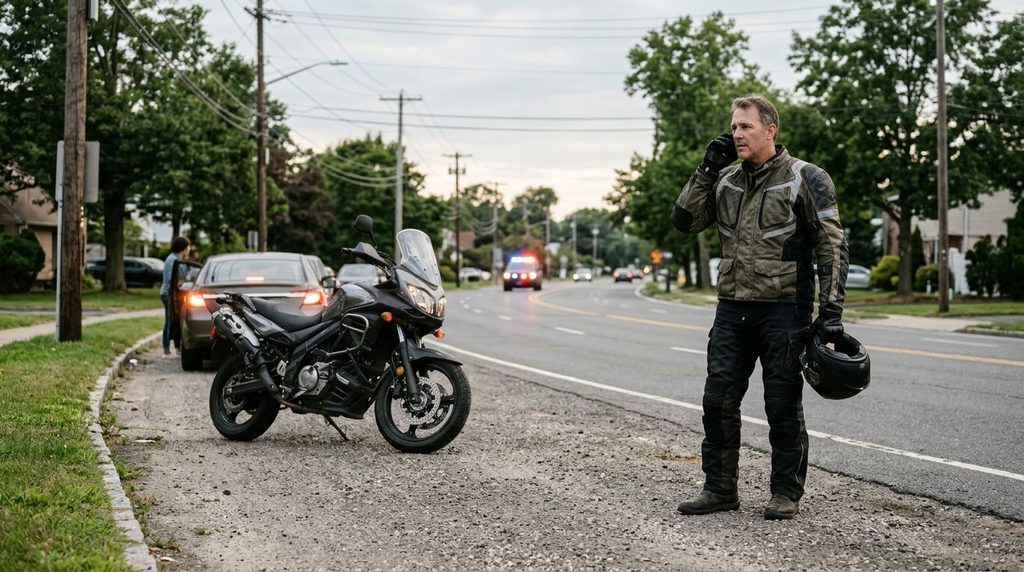
Immediate actions should focus on preventing additional injuries and obtaining appropriate assistance.
Move to Safety Without Aggravating Injuries
If a rider can move safely and has no suspected serious injury, moving away from active traffic may reduce the risk of another collision.
However, someone experiencing significant neck pain, back pain, weakness, numbness, or other signs of potentially serious trauma should avoid unnecessary movement.
Bystanders should not attempt to move a seriously injured person unless an immediate danger requires it. Emergency responders are trained to assess injuries and determine appropriate stabilization procedures.
If possible, warning lights or other safe measures may help alert approaching drivers.
Call 911 and Request Emergency Assistance
Emergency services should be contacted when someone is injured, there is an immediate safety hazard, or the situation requires police assistance.
When calling, provide the most accurate available location, including the road name, nearby intersection, exit number, or recognizable landmark.
Long Island motorcycle collisions may occur on major routes such as the Long Island Expressway, Northern State Parkway, Southern State Parkway, or local roads throughout Nassau and Suffolk counties.
Providing clear location information can help emergency personnel identify the crash scene.
Avoid Confrontations or Speculation About Fault
A crash can generate strong emotions, particularly when serious injuries or substantial property damage are involved.
Riders should avoid confrontations and limit discussions to necessary factual information.
Statements about fault should not be based on assumptions made before the accident has been investigated.
Being cooperative with police and emergency personnel is important, but a rider does not need to speculate about speed, impact dynamics, or the actions of another driver.
Why Is Medical Attention Important After a Motorcycle Accident?
Motorcycle riders are physically exposed during collisions, making them vulnerable to injuries that may not be immediately obvious.
Some symptoms develop gradually, and adrenaline may temporarily affect a person’s perception of pain.
A timely medical evaluation helps identify injuries that require treatment and creates records documenting the rider’s condition after the crash.
Common Motorcycle Crash Injuries
Motorcycle accidents can cause several types of injuries, including:
- Traumatic brain injuries and concussions.
- Neck and spinal injuries.
- Fractures involving arms, legs, ribs, or the pelvis.
- Road rash and skin abrasions.
- Ligament and tendon injuries.
- Internal bleeding or organ damage.
- Nerve injuries and mobility limitations.
Not every injury is visible externally. Persistent headaches, dizziness, abdominal pain, breathing difficulties, or changes in alertness may indicate a need for urgent evaluation.
The Centers for Disease Control and Prevention provides information about traumatic brain injuries, symptoms, and the importance of recognizing potential complications.
Follow Medical Recommendations
After receiving initial treatment, injured riders should follow the individualized instructions provided by their healthcare professionals.
This may include specialist appointments, imaging, physical therapy, medication, or further evaluation.
Medical records can help establish the nature of the injury, its progression, and the treatment required.
If symptoms change or new problems appear, those developments should be communicated accurately to a qualified medical provider.
Document the Recovery Process
Injuries may affect employment, transportation, sleep, and everyday activities.
Keeping organized records of treatment appointments, work restrictions, and related expenses can help demonstrate the consequences of the collision.
For more serious injuries, medical documentation may also be necessary to assess future treatment needs and long-term functional limitations.
How Do You Report a Motorcycle Accident on Long Island?
New York imposes specific reporting obligations for motor vehicle accidents, including qualifying motorcycle crashes.
The requirements depend on whether the collision caused injuries, a fatality, or property damage exceeding the applicable reporting threshold.
When Must a Motorcycle Accident Be Reported?
Under New York reporting rules, drivers involved in crashes resulting in injury or death, or damage exceeding $1,000 to any one person’s property, generally must submit a written crash report to the DMV within 10 days.
The required document is Form MV-104, Report of Motor Vehicle Crash.
The New York Department of Motor Vehicles explains these reporting requirements and distinguishes the driver’s DMV reporting obligation from notification to an insurance company.
NY DMV+1
A report filed by a responding police officer does not necessarily eliminate the involved driver’s separate reporting obligation.
What Information Should Be Included?
A crash report generally records important details about the collision.
| Information | Why It Matters |
| Date and Time | Establishes when the incident occurred |
| Crash Location | Identifies the roadway or intersection |
| Driver Information | Identifies involved vehicle operators |
| Vehicle Details | Documents the vehicles involved |
| Insurance Information | Helps identify relevant coverage |
| Injury Information | Records reported harm |
| Collision Circumstances | Provides an initial factual account |
Information should be accurate and based on what is known.
When an injured person cannot complete required reporting because of hospitalization or another serious circumstance, prompt advice about applicable reporting obligations may be necessary.
How Can Riders Obtain a Police Accident Report?
Police crash reports may become available through the relevant law enforcement agency or the New York DMV’s records system.
Depending on the crash location, the responding agency might be the Nassau County Police Department, Suffolk County Police Department, New York State Police, or another local agency.
Obtaining the report can help identify involved drivers, reported witness information, and the investigating officer’s observations.
However, a police report is not necessarily the final legal determination of negligence.
What Evidence Should Be Collected After a Motorcycle Crash?
Evidence collected shortly after a collision may help establish the accident sequence, identify responsible parties, and document the resulting damage.
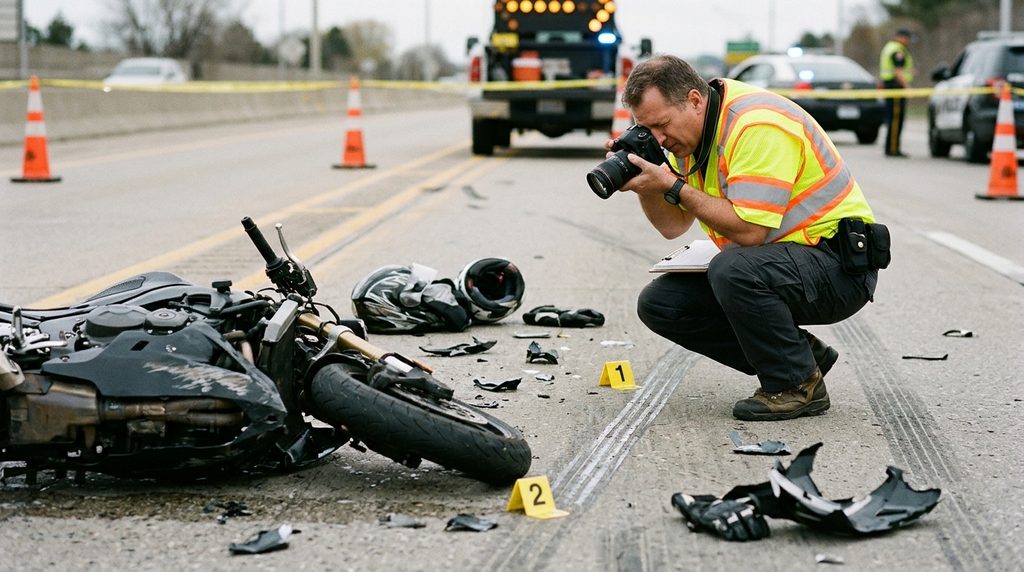
Because accident scenes change quickly, preserving available information can be especially valuable.
Photograph the Crash Scene
When safe and medically appropriate, riders or other individuals may photograph:
- The position of the motorcycle and other vehicles.
- Vehicle damage and apparent impact areas.
- Roadway markings and traffic signals.
- Skid marks and debris.
- Potholes, obstructions, or other road hazards.
- Weather and lighting conditions.
- Visible injuries and damaged riding equipment.
Wide photographs can establish the overall scene, while closer images can document specific details.
Photos should be preserved in their original format when possible to retain useful file information.
Gather Witness Information
Independent witnesses may provide important observations about vehicle movements, lane changes, traffic signals, or other circumstances.
Collecting names and contact information can make it easier to obtain statements later.
Witness accounts are particularly useful when drivers disagree about how the accident occurred.
A rider should not pressure witnesses to adopt a particular version of events.
Preserve the Motorcycle and Riding Equipment
Damaged equipment may contain physical evidence relevant to accident reconstruction or injury analysis.
Important items may include the motorcycle, helmet, gloves, jacket, protective boots, and other equipment worn during the collision.
Repairs, disposal, or modifications can make certain physical evidence unavailable.
When significant liability disputes are anticipated, appropriate inspection and documentation before major changes may be important.
What Information Should Be Exchanged With Other Drivers?
Exchanging accurate information helps establish the identities of involved parties and supports subsequent insurance communication.
A rider should obtain information directly when it is safe to do so or through the responding authorities when injuries prevent an exchange.
Essential Information to Collect
| Information Needed | Examples |
| Driver Identification | Full name and contact information |
| Vehicle Information | License plate, make, and model |
| Insurance Details | Insurer and policy identification |
| Vehicle Ownership | Registered owner when different from driver |
| Witness Information | Names and contact details |
| Police Information | Responding agency and report reference |
Accurate records can reduce confusion during the claims process.
Riders should also provide information legally required at the accident scene.
Why Vehicle Ownership Matters
The driver who caused an accident may not own the vehicle involved.
In some circumstances, New York law permits liability claims against a vehicle owner based on the driver’s permitted use.
Under New York Vehicle and Traffic Law Section 388, vehicle owners may bear responsibility for injuries resulting from negligence in the use or operation of their vehicles by persons operating with the owner’s permission.
The applicability of this rule depends on the vehicle, ownership circumstances, statutory provisions, and available evidence.
How Does Insurance Work After a Motorcycle Accident in New York?
Motorcycle insurance claims are different from ordinary automobile injury claims because New York’s no-fault insurance framework generally excludes motorcycle operators and passengers.
This distinction is important when riders face medical expenses and income losses after a collision.
Are Motorcyclists Covered by New York No-Fault Insurance?
Generally, motorcycle operators and passengers are not eligible for New York no-fault Personal Injury Protection benefits.
The New York Department of Financial Services confirms that motorcycle operators and passengers are excluded from these benefits and may pursue qualifying losses without the usual no-fault first-dollar restriction.
Department of Financial Services+1
This means injured riders may need to examine other available coverage and potential liability claims to address accident-related losses.
Certain limited-use vehicle classifications have different legal treatment, so the exact type of vehicle can matter.
What Insurance Coverage May Be Available?
Potential sources of compensation or payment may include the at-fault driver’s liability insurance, applicable motorcycle medical payments coverage, private health insurance, and uninsured or underinsured motorist coverage where available.
The actual availability of coverage depends on the policies, the type of loss, statutory rules, and circumstances of the collision.
An injured rider should not assume that every expense will automatically be covered.
Should Riders Give Recorded Statements to Insurance Adjusters?
Insurance companies may request descriptions of the accident and the resulting injuries.
Riders should communicate accurately and comply with applicable contractual duties. However, they should avoid guessing about accident details or offering unsupported medical conclusions.
A recorded statement to an opposing insurer may have consequences when liability or injury severity is disputed.
For complex claims, understanding the purpose and scope of a requested statement before providing it may be important.
How Is Fault Determined After a Long Island Motorcycle Accident?
Determining liability requires examining how the collision occurred and whether one or more parties acted negligently.
Motorcycle accidents may involve unsafe left turns, distracted driving, improper lane changes, failure to yield, speeding, or dangerous roadway conditions.
An investigation should focus on available evidence rather than assumptions about motorcyclists.
Common Causes of Motorcycle Accidents
Some frequent collision scenarios include:
- A driver turns left across an approaching motorcycle’s path.
- A vehicle changes lanes without checking for nearby motorcycles.
- A distracted driver fails to notice a motorcycle at an intersection.
- A driver follows a motorcycle too closely.
- A motorist opens a vehicle door into a rider’s path.
- Poorly maintained roadway conditions contribute to a loss of control.
Responsibility depends on the specific circumstances.
Multiple parties may share fault, and a serious injury does not automatically establish negligence by another driver.
How Comparative Negligence Affects Compensation
New York follows a pure comparative negligence system.
Under New York CPLR Section 1411, a claimant’s share of responsibility generally reduces recoverable damages proportionally rather than automatically preventing recovery.
For example, suppose a motorcycle accident results in $100,000 in legally recoverable damages.
If the rider is assigned 20% of the responsibility, the damages would generally be reduced to $80,000.
This example does not account for insurance policy limits, other legal defenses, or collection issues.
Why Independent Investigation Matters
A police report may provide valuable information, but additional evidence can become necessary when the parties disagree about the collision.
Traffic recordings, physical damage, witness accounts, and accident reconstruction may help establish vehicle movements and potential violations.
When a crash involves complicated liability questions, consulting a qualified motorcycle accident lawyer Long Islandmay help an injured rider understand the available evidence and applicable legal options.
What Compensation Can Injured Motorcyclists Recover?
A motorcycle accident claim may involve both economic and non-economic damages.
The availability and amount of compensation depend on liability, medical evidence, applicable insurance coverage, and the specific consequences of the injuries.
Economic Damages
Economic damages represent financial losses that can be measured through documentation.
| Damage Category | Potential Supporting Evidence |
| Medical Expenses | Hospital bills, treatment records, and invoices |
| Lost Wages | Pay statements and employer records |
| Future Medical Care | Physician opinions and treatment projections |
| Reduced Earning Capacity | Employment history and vocational evaluations |
| Rehabilitation Expenses | Therapy invoices and medical recommendations |
| Property Damage | Repair estimates and motorcycle valuations |
Future losses may require expert evidence when the rider experiences permanent physical restrictions or reduced employment capacity.
Non-Economic Damages
Non-economic damages may include physical pain, emotional suffering, loss of enjoyment of life, and limitations affecting ordinary activities.
These losses do not have a fixed monetary calculation.
Medical documentation, testimony, and evidence concerning the rider’s daily functioning may help establish their extent.
What If the Rider Suffers Permanent Injuries?
Permanent injuries can create substantial long-term consequences.
A spinal injury, traumatic brain injury, or complex orthopedic condition may affect mobility, independence, employment, and future medical needs.
Determining potential compensation may require medical specialists, economic professionals, and other qualified experts.
What Mistakes Should Riders Avoid After a Motorcycle Accident?
Certain actions can complicate the investigation or make relevant evidence more difficult to obtain.
Understanding these risks can help injured riders make informed decisions.
Delaying Medical Evaluation
Waiting to seek medical attention can create health risks and complicate documentation of accident-related injuries.
Some symptoms develop gradually, and the absence of immediate pain does not necessarily establish the absence of injury.
Repairing or Disposing of the Motorcycle Too Early
Physical damage may provide information about how a collision occurred.
Repairing or disposing of the motorcycle before appropriate documentation or inspection can make some evidence unavailable.
Making Unsupported Statements About Fault
A rider may not know every factor that contributed to a collision immediately afterward.
Statements based on guesses about speed, visibility, or another driver’s actions may create inconsistencies during later investigations.
Accepting a Settlement Before Understanding the Injuries
Some injuries require extended treatment, and their long-term consequences may not be clear immediately.
Accepting a settlement that includes a broad release of claims may prevent further recovery for covered injuries.
Missing Legal or Insurance Deadlines
Accident reporting obligations, insurance notification requirements, and lawsuit filing deadlines are separate matters.
Completing one requirement does not necessarily satisfy the others.
How Long Do Riders Have to File a Motorcycle Accident Lawsuit?
New York generally provides a three-year statute of limitations for negligence-based personal injury lawsuits.
Under CPLR Section 214(5), the period usually begins on the date of injury. However, exceptions and different filing periods may apply in particular circumstances.
The New York Courts statute of limitations timetable identifies the general three-year deadline for ordinary negligence-related personal injury actions.
New York Courts
Are Claims Against Government Entities Different?
Yes. Motorcycle crashes involving allegedly dangerous public roadway conditions or government-owned vehicles may trigger special requirements.
Depending on the responsible entity and applicable law, a notice of claim may be required within 90 days.
Other requirements, including shorter lawsuit deadlines, may also apply.
New York Courts+1
Because these deadlines can be substantially shorter than the ordinary three-year period, prompt evaluation is important.
Do Insurance Negotiations Pause the Deadline?
Negotiating with an insurer does not automatically extend the deadline for filing a lawsuit.
A claimant may lose the ability to pursue an otherwise valid claim if the applicable limitation period expires.
Injured riders should identify all relevant deadlines rather than assuming that an open insurance claim preserves their legal rights.
When Should an Injured Motorcyclist Contact an Attorney?
Legal representation may be particularly useful when a crash causes serious injuries, significant financial losses, disputed liability, or uncertainty about available insurance coverage.

A personal injury attorney can review the circumstances, help identify potentially responsible parties, and assess the evidence supporting a claim.
Situations That May Require Legal Assistance
Legal guidance may be valuable when:
- The at-fault driver disputes responsibility.
- The crash involves multiple vehicles.
- Serious or permanent injuries occur.
- Insurance coverage is insufficient or disputed.
- A commercial vehicle is involved.
- Dangerous roadway conditions may have contributed.
- The insurer denies the claim or disputes significant damages.
The appropriate legal strategy depends on the facts.
What Can an Attorney Do After a Motorcycle Crash?
Depending on the circumstances, legal representation may involve obtaining records, investigating liability, coordinating expert evaluations, communicating with insurers, and assessing available damages.
Qualified New York personal injury attorneys can also explain relevant filing deadlines and whether litigation may be appropriate.
An attorney’s involvement does not guarantee a particular settlement or court outcome.
Preparing for a Legal Consultation
An injured person can organize available information before seeking legal advice.
Useful materials may include the police report, accident photographs, medical records, insurance correspondence, employment documentation, and witness information.
When additional guidance is needed, injured riders can request a free consultation to discuss the accident and potential legal options.
Frequently Asked Questions
1. What is the first thing to do after a motorcycle accident on Long Island?
The first priority is personal safety and emergency medical assistance. Riders should call 911 when necessary, avoid additional roadway hazards, and obtain medical evaluation for injuries. Police reporting, evidence preservation, and insurance communication should follow when it is safe and appropriate.
2. Do motorcycle accidents have to be reported to the New York DMV?
Yes, qualifying crashes must generally be reported within 10 days when they cause injury, death, or more than $1,000 in damage to any one person’s property. The required document is Form MV-104. Reporting the accident to an insurance company does not replace the DMV filing requirement.
3. Can a rider recover compensation if partly responsible for the accident?
Yes. New York’s pure comparative negligence system generally permits recovery even when the injured rider shares responsibility. However, the recoverable damages are reduced in proportion to the rider’s assigned fault. Other legal and insurance considerations may affect the ultimate recovery.
4. Does New York no-fault insurance pay motorcycle accident medical bills?
Generally, motorcycle operators and passengers are excluded from New York’s no-fault Personal Injury Protection benefits. Other available insurance, including applicable medical payments or health coverage, may help address expenses. Riders may also pursue qualifying liability claims against responsible parties.
5. How long does a motorcycle accident claim take to settle?
There is no universal settlement timeline. Cases involving clear liability, completed medical treatment, and well-documented losses may resolve more quickly than claims involving permanent injuries, disputed fault, multiple parties, or litigation. Settlement timing depends on the facts, available evidence, and negotiation process.
Conclusion
The actions taken after a motorcycle crash on Long Island can affect personal safety, access to medical treatment, and the ability to pursue compensation.
Riders should prioritize emergency care, comply with reporting requirements, preserve available evidence, document medical and financial losses, and understand how New York motorcycle insurance rules affect their claims.
Because liability disputes, serious injuries, and legal deadlines can complicate the recovery process, timely documentation and informed legal guidance may help injured motorcyclists protect their rights and make appropriate decisions.