

Women’s jogger scrub pants combine a tapered leg, fitted ankle, and modern athletic-inspired silhouette with the practical features expected from medical workwear. Choosing the right pair involves more than selecting a size. Waistband construction, rise, thigh and calf room, inseam, stretch, pocket placement, and workplace requirements can all affect comfort during a healthcare shift. Professionals exploring women’s jogger scrub pants should evaluate the complete fit while standing, sitting, walking, bending, and reaching.
Key Takeaways
- Women’s jogger scrub pants have a tapered leg that usually ends with a fitted or elasticized ankle.
- Waistband fit is important because joggers should stay secure without excessive pressure.
- The correct rise allows comfortable sitting, bending, and movement.
- Thigh, knee, calf, and ankle fit should all be checked separately.
- Joggers can provide a streamlined alternative to traditional open-hem scrub pants.
- Stretch can support movement but does not compensate for an incorrect size.
- Pocket placement should match the items normally carried during work.
- Petite, regular, and tall length options can be useful when available.
- Workplace dress codes should be checked before selecting a jogger style.
- A practical fit test is more useful than choosing solely by appearance.
What Are Women’s Jogger Scrub Pants?
Women’s jogger scrub pants are medical work pants designed with a tapered silhouette that narrows toward the lower leg and typically finishes with an elasticized or knit cuff.
Unlike traditional straight-leg scrub pants, joggers generally create a closer fit around the ankle.
Common features include:
- Elastic waistbands
- Drawstrings
- Stretch fabrics
- Tapered legs
- Elastic or knit ankle cuffs
- Cargo pockets
- Front pockets
- Cell-phone pockets
The exact construction varies by manufacturer and collection.
Some joggers have a relaxed fit through the thigh before narrowing toward the ankle. Others have a more tailored silhouette throughout the leg.
This means that “jogger” describes the general pant shape, not one standardized fit.
Why Are Jogger Scrub Pants Popular?
Jogger scrubs have become a common alternative to traditional scrub pants because they combine practical healthcare workwear with a more contemporary silhouette.
A tapered appearance
The narrower lower leg creates a defined outline compared with loose straight-leg scrub pants.
This can appeal to healthcare professionals who prefer:
- A streamlined appearance
- Less fabric around the ankles
- A modern workwear silhouette
- A closer-fitting lower leg
Reduced lower-leg fabric
Some professionals prefer not having excess fabric around the ankle.
A jogger cuff keeps the lower portion of the pant closer to the leg.
This can be particularly noticeable when walking, sitting, or moving quickly between work areas.
Compatibility with common work footwear
The tapered lower leg can pair naturally with many types of healthcare footwear.
The important consideration is still comfort.
A cuff should not feel excessively tight around the ankle or interfere with socks or shoes.
Are Women’s Jogger Scrub Pants Comfortable for Long Shifts?
They can be, but comfort depends on the complete garment rather than the jogger silhouette alone.
For extended shifts, evaluate:
- Waistband pressure
- Rise
- Hip fit
- Thigh room
- Knee movement
- Calf room
- Ankle cuff
- Fabric stretch
- Pocket weight
- Inseam
A jogger with an attractive silhouette can still become uncomfortable if the waistband is too tight or the calf is too narrow.
The best approach is to evaluate the entire pant during realistic movement.
Test the waistband while sitting
Healthcare professionals often alternate between standing, walking, sitting, and bending.
A waistband that feels comfortable while standing can feel different when seated.
Check whether it:
- Rolls
- Pinches
- Slides
- Creates excessive pressure
- Requires repeated adjustment
A drawstring can help fine-tune fit, but it should not need to be pulled excessively tight.
How Should Women’s Jogger Scrub Pants Fit?
A well-fitting jogger should follow the general shape of the leg without becoming restrictive.

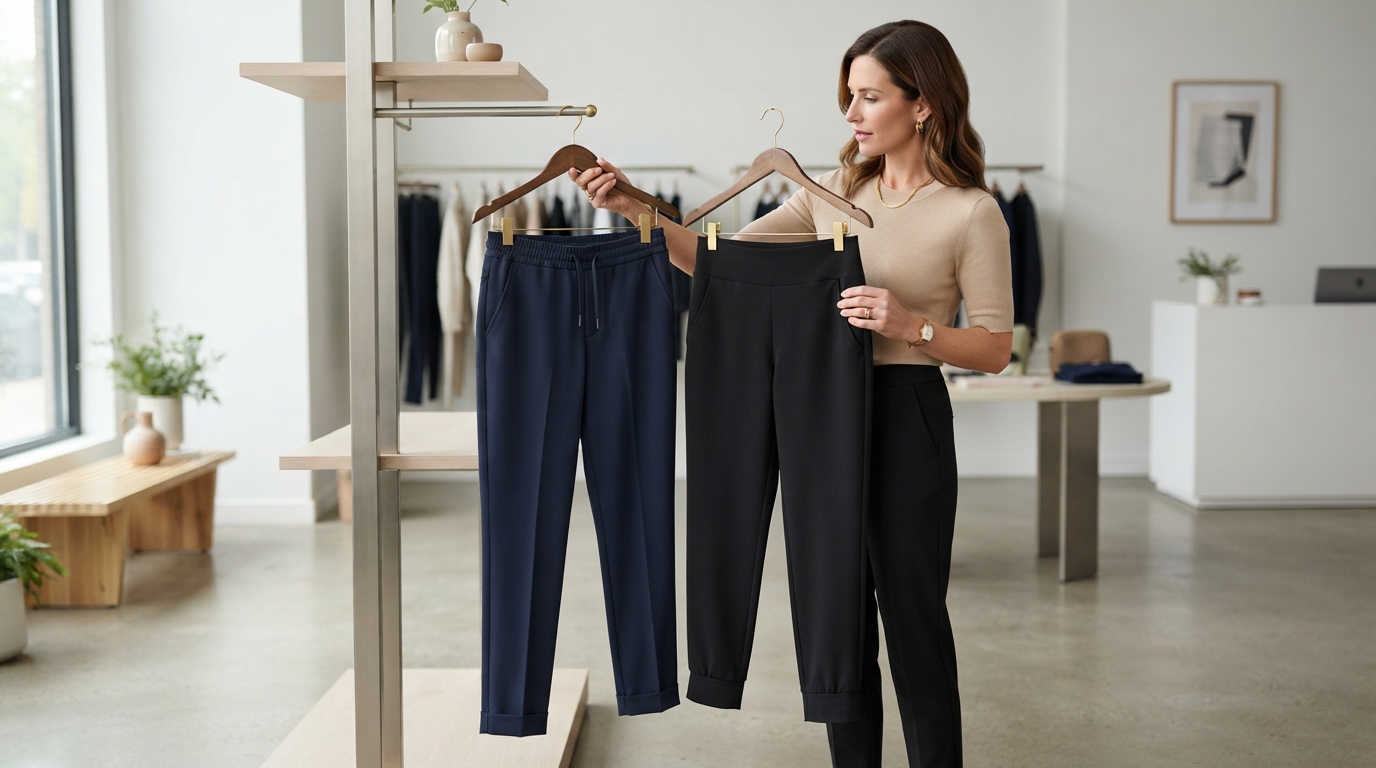
ALT: Healthcare professional testing movement while wearing jogger scrub pants
The ideal fit typically provides:
- Secure waist placement
- Comfortable hip room
- Appropriate thigh room
- Free knee movement
- Controlled calf fit
- Comfortable ankle cuff
- Appropriate length
Waist fit
The waistband should remain secure during walking and bending.
A good test is to walk, sit, stand, and bend without repeatedly pulling the pants upward.
Hip fit
The pants should provide enough room through the hips without excessive fabric.
Watch for:
- Strong horizontal pulling
- Pocket distortion
- Excessive bunching
- Unnecessary looseness
Thigh fit
The thigh should allow normal movement.
Healthcare professionals can test this by:
- Sitting down.
- Standing up.
- Bending the knees.
- Taking several steps.
- Walking up and down stairs if appropriate during fitting.
Knee fit
The knee area should move naturally.
Excessive tension when bending can indicate that the pant is too narrow through the leg.
Calf fit
The calf is particularly important with joggers because the leg narrows toward the ankle.
A jogger should not create uncomfortable pressure around the calf.
Ankle cuff
The cuff should sit securely without feeling restrictive.
Consider whether the cuff works comfortably with the shoes and socks normally worn during work.
What Is the Difference Between Jogger and Traditional Scrub Pants?
The main distinction is the lower-leg silhouette.
| Feature | Jogger Scrub Pants | Traditional Scrub Pants |
| Leg shape | Tapered | Straight or relaxed |
| Ankle | Usually cuffed | Usually open hem |
| Lower-leg fabric | More controlled | Typically more relaxed |
| Appearance | Modern, athletic-inspired | Traditional clinical |
| Mobility | Depends on garment fit | Depends on garment fit |
| Footwear interaction | More defined around ankle | More fabric around footwear |
| Style preference | Streamlined | Classic |
Neither style is universally better.
The appropriate choice depends on lower-leg preference, workplace requirements, movement, footwear, and personal comfort.
How Important Is the Waistband in Women’s Jogger Scrubs?
The waistband is one of the most important features to evaluate.

Women’s jogger scrub pants may use:
- Full elastic waistbands
- Yoga-style waistbands
- Elastic plus drawstring
- Knit waistbands
- Other combinations
Each construction can feel different.
Elastic waistband
A full elastic waistband provides a simple pull-on design.
Check:
- Pressure around the waist
- Stability
- Stretch recovery
- Rolling
- Comfort while seated
Drawstring waistband
A drawstring allows additional adjustment.
It can be useful when the wearer wants to fine-tune waist security.
However, excessive tightening can create pressure.
Yoga-style waistband
A wider knit waistband can provide a different feel around the waist and may appeal to professionals who prefer broader waist coverage.
The waistband should still be tested while sitting and bending.
How Does Rise Affect Jogger Scrub Fit?
Rise describes the distance from the crotch area to the top of the waistband.
It affects where the pant sits on the body.
A suitable rise should allow comfortable movement without creating excessive pressure or unwanted shifting.
Signs the rise may be too short
- Crotch restriction
- Waistband pulling downward when sitting
- Reduced back coverage
- Strong tension when bending
Signs the rise may be too long
- Excess fabric through the crotch
- Waistband sitting higher than preferred
- Unwanted bunching
- Altered leg positioning
A professional should evaluate the rise while both standing and sitting.
How Important Is Stretch in Women’s Jogger Scrub Pants?
Stretch can improve freedom of movement, particularly when bending, squatting, sitting, and reaching.
Common stretch fibers include:
- Spandex
- Elastane
However, stretch percentage alone does not determine comfort.
Two garments with similar fiber content can feel different because of:
- Fabric construction
- Weight
- Garment cut
- Stretch recovery
- Finishing
A flexible fabric cannot make a poorly fitted pant comfortable.
The size and cut should be appropriate first.
What Fabric Should You Look for in Women’s Jogger Scrub Pants?
There is no universally ideal scrub fabric.
Different healthcare professionals prefer different fabric characteristics.
Polyester blends
Polyester is commonly used in medical workwear because it can contribute to durability and easy-care characteristics.
Rayon blends
Rayon can contribute to a softer hand feel and fluid drape.
Spandex or elastane blends
Stretch fibers can provide additional flexibility.
Recycled polyester
Some modern scrub collections incorporate recycled polyester as part of their fabric composition.
For example, Maevn scrub pants are available within performance-oriented scrub collections that can be considered alongside other modern jogger styles.
The important point is to evaluate the actual fabric and garment construction rather than choosing based on one fiber name alone.
How Should You Choose the Length of Women’s Jogger Scrub Pants?
Length matters even with joggers.
The cuff should finish at an appropriate position without excessive bunching or pulling.
Consider:
- Height
- Inseam
- Leg proportions
- Ankle position
- Footwear
- Personal style preference
Petite fit
Shorter inseams can help reduce excess fabric.
A pant that is too long may create unnecessary bunching around the ankle.
Regular fit
Regular lengths may suit a broad range of average-height wearers, but the actual garment measurements should still be checked.
Tall fit
Tall options can provide additional length without requiring a larger overall pant size.
This is important because increasing the waist or overall size merely to gain length can create an unnecessarily loose fit elsewhere.
Should You Size Up in Jogger Scrub Pants?
Not automatically.
Sizing up may provide additional room through the hips or thighs, but it can also create:
- A loose waistband
- Excess fabric
- Larger pockets
- A less defined silhouette
If the problem is length, check whether a different inseam is available before increasing the overall size.
If the issue is calf or thigh room, compare the garment’s measurements and intended fit rather than assuming the next size will solve everything.
How Should Pocket Design Affect Your Choice?
Pocket placement is particularly important in healthcare workwear.
Common jogger features include:
- Front pockets
- Cargo pockets
- Back pockets
- Cell-phone pockets
- Zippered pockets
The right configuration depends on what the wearer actually carries.
Front pockets
These can provide quick access to lightweight items.
Cargo pockets
Cargo pockets can provide additional storage without relying entirely on the scrub top.
However, excessive pocket loading can change how the pant hangs.
Cell-phone pockets
A dedicated phone pocket can make the device easier to access while reducing interference with other stored items.
Zippered pockets
These can provide additional security for small items.
More storage is not always better.
A practical pocket configuration should match the actual workday.
Are Women’s Jogger Scrubs Suitable for Nurses?
Jogger scrub pants can be suitable for nurses when they meet the workplace’s uniform requirements and provide appropriate fit and movement.
Nurses may benefit from evaluating:
- Waistband stability
- Hip and thigh room
- Knee mobility
- Calf fit
- Ankle cuff comfort
- Pocket capacity
- Fabric stretch
Nursing work can involve frequent walking, standing, bending, and position changes.
The pant should therefore be tested under realistic movement.
A jogger should not be selected solely because it looks modern.
Are Jogger Scrubs Suitable for Medical Assistants?
Medical assistants often alternate between clinical and administrative tasks.
They may spend part of the day:
- Walking between rooms
- Preparing patients
- Standing
- Sitting
- Documenting information
A jogger can provide a streamlined silhouette while still supporting movement when correctly fitted.
For medical assistants, seated comfort deserves particular attention because the pant may be worn for both active and desk-based tasks.
Can Doctors Wear Women’s Jogger Scrub Pants?
Women’s jogger scrub pants can be appropriate for physicians and other healthcare professionals when the style complies with workplace requirements.
The relevant considerations include:
- Dress code
- Approved colors
- Professional appearance
- Movement
- Pocket needs
- Fit
Some clinical workplaces may prefer traditional scrub silhouettes, while others may permit modern jogger designs.
The facility’s policy should determine what is appropriate.
Are Jogger Scrubs Appropriate for Veterinary Professionals?
Veterinary professionals can have movement-intensive workdays.
Tasks may include:
- Walking between treatment areas
- Bending
- Squatting
- Handling equipment
- Assisting with animal care
For these roles, knee and thigh mobility are particularly important.
A jogger should provide enough room for normal movement while maintaining a secure lower-leg fit.
Pocket placement may also matter because storage needs can differ from those of office-based healthcare workers.
How Should Women’s Jogger Scrub Pants Be Paired With Scrub Tops?
Jogger pants can be paired with many different scrub top silhouettes.
Common combinations include:
- V-neck top + joggers
- Mock-wrap top + joggers
- Relaxed top + joggers
- Tuckable top + joggers
The best combination depends on the desired overall silhouette.
Tucked top
A tuckable top can emphasize the waistband and create a more defined appearance.
Untucked top
An untucked top can provide additional torso coverage and a more relaxed appearance.
Shaped top
A shaped top can balance the tapered lower-leg silhouette.
The complete outfit should be assessed rather than selecting the top and pants independently.
What Are the Advantages of Women’s Jogger Scrub Pants?
Jogger scrubs can offer several practical and style-related benefits.
Modern silhouette
The tapered shape provides a contemporary alternative to traditional scrub pants.
Controlled ankle fit
The cuff keeps the lower leg closer to the body.
Reduced excess fabric
Some professionals prefer having less loose material around the ankles.
Flexible fabric options
Many modern joggers incorporate stretch fabrics.
Multiple pocket configurations
Jogger designs can include practical storage options.
Broad styling options
They can work with traditional, fitted, or modern scrub tops.
What Are the Potential Drawbacks?
Joggers are not ideal for every wearer or work environment.
Potential considerations include:
Ankle restriction
A cuff that is too tight can become uncomfortable.
Calf fit
Tapered legs may feel restrictive for people who prefer more room below the knee.
Workplace dress codes
Some facilities may have specific requirements regarding pant styles.
Less traditional appearance
Professionals who prefer classic straight-leg scrubs may not like the jogger silhouette.
Limited length flexibility
Some styles may not offer enough length options for every body proportion.
The solution is to evaluate the individual garment rather than assuming all joggers fit the same way.
How Should You Compare Different Women’s Jogger Scrub Pants?
Use a feature-by-feature comparison rather than focusing only on brand or appearance.
| Factor | Questions to Ask |
| Waistband | Does it stay secure without pressure? |
| Rise | Is it comfortable while sitting? |
| Hip | Is there enough room without sagging? |
| Thigh | Can the legs move freely? |
| Knee | Can you bend comfortably? |
| Calf | Does the taper feel restrictive? |
| Cuff | Is the ankle comfortable? |
| Length | Does the pant finish at the intended position? |
| Fabric | Does it feel suitable for the work environment? |
| Stretch | Does it support normal movement? |
| Pockets | Are they useful for actual work needs? |
| Care | Are the laundering requirements practical? |
This approach helps separate marketing descriptions from the features that actually matter during wear.
How Should You Care for Women’s Jogger Scrub Pants?
Always follow the garment’s specific care label.
Care requirements can vary depending on fabric composition and construction.
Check instructions for:
- Washing temperature
- Drying
- Bleaching
- Ironing
- Special care requirements
The Federal Trade Commission explains that covered apparel should include appropriate care information so consumers can follow the manufacturer’s recommended cleaning methods. (FTC Care Labeling)
Avoid assuming that all jogger scrubs can be washed using the same routine.
Common Mistakes When Buying Women’s Jogger Scrub Pants
Choosing by appearance alone
A jogger can look excellent on a product page but fit differently on an individual body.
Ignoring the waistband
The waistband affects comfort throughout the entire shift.
Forgetting the calf
The tapered leg should be evaluated below the knee, not just around the waist.
Buying a larger size for extra length
Check available inseams before changing the overall size.
Overloading pockets
Heavy pocket contents can alter how the pants hang and move.
Assuming stretch solves every fit issue
Stretch supports movement but cannot correct incorrect proportions.
Ignoring footwear
The ankle cuff and pant length should work with the shoes normally worn during work.
Forgetting workplace requirements
Modern joggers may not be permitted in every healthcare environment.
Women’s Jogger Scrub Pants Buying Checklist
Before purchasing, check:
- Waist: Does it stay secure without excessive pressure?
- Rise: Is it comfortable while sitting and bending?
- Hips: Is there enough room without sagging?
- Thighs: Can you move freely?
- Knees: Can you bend comfortably?
- Calves: Does the taper provide adequate room?
- Cuff: Does it sit comfortably around the ankle?
- Length: Is the inseam appropriate?
- Fabric: Does the material feel suitable for the workplace?
- Stretch: Does it support normal movement?
- Pockets: Are they positioned for actual work needs?
- Shoes: Does the lower-leg design work with your footwear?
- Care: Are the laundry requirements practical?
- Workplace: Is the style permitted?
Healthcare professionals who want to evaluate scrub fabrics, jogger silhouettes, and sizing in person can also visit a medical scrub store in Wilmington before choosing their workwear.
Final Thoughts
Women’s jogger scrub pants provide a modern alternative to traditional scrub trousers, but their tapered design makes fit especially important. The waistband, rise, thigh, knee, calf, ankle cuff, and inseam all contribute to how the pants feel during a healthcare shift.
A good jogger should stay secure without creating excessive pressure and allow normal movement without becoming loose or restrictive in the wrong areas.
Fabric and stretch also matter, but they should be considered alongside garment construction. Likewise, pockets should be selected according to actual work needs rather than simply choosing the pair with the greatest number of storage compartments.
Professionals considering jogger scrub pants for women should evaluate the complete garment while standing, sitting, walking, bending, and reaching.
The right pair is ultimately the one that combines an appropriate silhouette with secure fit, practical storage, comfortable movement, and workplace compatibility.
Frequently Asked Questions
Are women’s jogger scrub pants comfortable for long shifts?
They can be, provided the waistband, rise, thigh, calf, ankle cuff, and fabric are appropriately fitted. Long-shift comfort depends more on the complete garment and individual fit than on the jogger style alone.
Should women’s jogger scrub pants be tight?
Joggers are designed to have a more tapered silhouette, but they should not be uncomfortably tight. The waist should remain secure while the hips, thighs, knees, calves, and ankles should allow normal movement without excessive restriction.
Are jogger scrub pants better than traditional scrub pants?
Neither style is universally better. Joggers provide a tapered, cuffed silhouette, while traditional scrub pants usually offer a straighter or more relaxed leg. Workplace requirements, movement needs, footwear, and personal preference should guide the choice.
What should women wear with jogger scrub pants?
Joggers can be paired with V-neck, mock-wrap, relaxed, or tuckable scrub tops. The best combination depends on preferred coverage, fit, workplace requirements, and the overall silhouette the wearer wants.
How do you choose the right size for women’s jogger scrubs?
Use the specific garment’s current size chart and consider waist, hip, inseam, and intended fit. Do not automatically size up for additional length or size down because of a preferred silhouette. The garment should be evaluated across the entire leg.