

Scrub fabric affects how medical workwear moves, feels, dries, and responds to repeated laundering. The best fabric is not automatically the softest or the stretchiest. Healthcare professionals should consider the full garment, including fiber blend, fabric construction, fit, weight, pocket load, layering, and care instructions.
For example, performance-focused EPIC by IRG scrubs use a polyester, recycled polyester, and spandex blend in current official product descriptions, with the manufacturer highlighting stretch, quick-dry performance, and low-maintenance wear.
Understanding what these fabric terms actually mean makes it easier to choose scrubs according to real workday needs rather than marketing language alone.
Key Takeaways
- Breathability and moisture wicking are related concepts, but they do not mean exactly the same thing.
- Stretch can come from elastic fibers or the construction of the fabric.
- More stretch does not correct an unsuitable size, rise, or inseam.
- Fabric weight and layering can influence how a uniform feels during active work.
- Durability should be considered in relation to friction, pocket load, laundering, and garment construction.
- Quick-dry and wrinkle-resistant features can simplify a workwear routine.
- Always follow the care instructions attached to the garment.
- Compare the entire scrub design instead of selecting by fiber percentage alone.
The right scrub fabric is the one that performs appropriately for the wearer’s work environment, movement, fit preferences, and normal laundry routine.
Why does scrub fabric matter for healthcare work?
Healthcare professionals can spend significant portions of a shift walking, standing, sitting, reaching, and changing position. Clothing is only one part of the work environment, but a uniform that feels heavy, restrictive, or difficult to maintain can become distracting.
Fabric influences several parts of the wearing experience:
- Garment weight
- Surface feel
- Stretch
- Drape
- Drying behavior
- Moisture management
- Wrinkle appearance
- Resistance to surface wear
- Laundry requirements
These factors work together.
A lightweight fabric with poor garment fit may still feel uncomfortable. A highly stretchy pant can still slip when the waistband is too large. A soft top may not provide the structured appearance a particular healthcare office wants.
Scrub fabric should therefore be evaluated as part of the complete garment.
What does breathable scrub fabric actually mean?
“Breathable” is widely used in clothing descriptions, but shoppers should look beyond the word itself.
In practical terms, workers are often asking:
Will this scrub fabric feel comfortable when I am moving, layering, or working in a warm environment?
Several factors can influence that experience.

Air movement through the garment
Fabric structure can affect how easily air moves through a textile.
However, the total clothing system matters. A scrub top worn over a long-sleeve underscrub and beneath a jacket will feel different from the same top worn alone.
Garment fit also matters. Extremely close-fitting clothing may create a different wearing experience from a relaxed silhouette, even when the fabric composition is identical.
Fabric weight
Lightweight scrubs may appeal to healthcare professionals who prefer less garment weight or work in warm indoor environments.
A heavier fabric may provide more structure and a different drape.
Neither is automatically better.
The preferred weight depends on:
- Workplace temperature
- Activity level
- Layering
- Personal preference
- Desired garment structure
Clothing is only one heat-related factor
NIOSH explains that occupational heat stress can involve environmental heat, metabolic heat, clothing, and personal protective equipment. Certain clothing ensembles and PPE may add to the body’s heat burden in hot work conditions.
The NIOSH heat stress guidance is useful for understanding the broader workplace issue.
A breathable scrub should not be presented as protection against heat illness. Workplace heat controls, hydration practices, rest procedures, and employer safety policies are separate considerations.
Is moisture wicking the same as breathability?
No. The terms describe different aspects of fabric performance.
Breathability generally relates to the movement of air or vapor through clothing.
Moisture-wicking claims typically describe a fabric’s ability to move moisture away from the skin or distribute it through the textile.
A fabric can be marketed for moisture management without being the lightest fabric available. Similarly, a lightweight textile is not automatically a technical wicking fabric.
Why wicking may matter during active shifts
Healthcare professionals who move frequently may prefer fabrics designed to manage moisture.
The official Med Couture Insight collection describes its performance fabric as having wicking properties while also emphasizing softness, stretch, and drape. The manufacturer identifies the fabric as 100% polyester.
Healthcare workers reviewing Med Couture Insight scrubs may therefore consider moisture-management characteristics alongside fit, pant style, pocket configuration, and workplace dress requirements.
Wicking alone should not determine the purchase.
The whole garment still needs to fit properly.
What does stretch mean in medical scrubs?
Stretch describes a fabric’s ability to extend and recover when the wearer moves.
In medical scrubs, stretch can be especially noticeable during:
- Reaching
- Sitting
- Bending
- Walking
- Squatting
- Raising the arms
- Moving from sitting to standing
However, not every stretch fabric behaves identically.
Spandex and elastane in scrub blends
Spandex, also called elastane in some markets, is commonly included in clothing blends to add elasticity.
A relatively small percentage can affect how a fabric responds to movement.
This does not mean a higher spandex percentage automatically creates a better scrub.
The garment pattern, waistband, seams, and overall fit remain important.
Mechanical stretch
Some fabrics can provide movement through textile construction rather than relying only on a high percentage of elastic fiber.
This is why reading a fiber label alone does not always explain exactly how a garment will feel.
The best test remains practical movement.
What do two-way and four-way stretch mean?
These terms generally describe the directions in which the fabric is designed to stretch.
Two-way stretch usually emphasizes movement in one primary direction across the fabric.
Four-way stretch generally describes stretch in multiple directions.
Some scrub brands use their own performance terminology. IRG, for example, describes current EPIC products as providing “360 stretch” within its official product information.
These descriptions can help shoppers understand the intended fabric performance, but actual garment fit should still be tested.
Can more stretch make scrubs fit better?
Sometimes stretch makes a garment more forgiving during movement, but it does not solve every fit problem.
Stretch cannot automatically correct:
- An inseam that is too long
- A waistband that is too loose
- A rise that feels too short
- A scrub top that is oversized
- Restricted shoulder proportions
- Excess fabric at the ankle
For example, a stretchy jogger may still pull through the calf if the leg shape is unsuitable for the wearer.
A highly flexible top may still shift when it is too large through the shoulders.
The practical rule is:
Use stretch to support movement, not to compensate for the wrong size or garment proportion.
How does nylon feel in scrub fabric?
Nylon is used in some performance apparel and scrub blends, often in combination with an elastic fiber.
The exact wearing experience depends on the fabric construction and garment.
The official Maevn Embrace collection identifies a nylon and spandex blend and describes the collection around a comfortable slim fit with elevated design details.
When considering Embrace by Maevn scrubs, the fabric should therefore be evaluated together with the collection’s closer fit and available garment silhouettes.
Why garment cut matters with a performance fabric
A slim-fit top and a relaxed top made from performance-oriented fabrics can still feel very different.
Consider:
- Shoulder width
- Chest room
- Top length
- Side shaping
- Pant rise
- Thigh room
- Leg shape
Fabric and cut create the final fit together.
A shopper who likes smooth stretch fabric may still prefer a different collection because of the rise or pant silhouette.
What role does polyester play in medical scrubs?
Polyester is widely used in modern workwear and scrub fabric.
However, “polyester scrubs” is an extremely broad category.
One polyester textile may be lightweight and flexible. Another may feel more structured. Different fabrics can have different finishes, yarns, weights, and construction methods.
Recycled polyester in scrub fabric
Some current scrub collections incorporate recycled polyester into their blends.
Official IRG product information for EPIC identifies polyester, recycled polyester, and spandex in multiple products. The brand also describes the resulting fabric around stretch, quick-dry properties, and lower-maintenance wear.
A recycled content claim does not by itself describe the fit of the garment.
Shoppers should still consider:
- Top construction
- Pant rise
- Inseam
- Pocket layout
- Stretch
- Fabric weight
- Care instructions
Fiber content is one part of the buying decision.
Does rayon make scrubs more comfortable?
Rayon is used in some scrub and apparel blends, but comfort should not be predicted from the word “rayon” alone.
A blended fabric may combine several fibers to create a particular feel, drape, or stretch characteristic.
Two rayon-containing scrub collections can still perform differently because of differences in:
- Fiber percentages
- Yarn construction
- Fabric weight
- Finishing
- Garment design
Rather than assuming a rayon blend will always feel softer or cooler, evaluate the actual garment.
This same principle applies to polyester, nylon, and spandex.
Fiber names provide useful information, but they do not tell the entire story of the fabric.
What makes scrub fabric durable?
Durability is not one single characteristic.
A healthcare worker may use “durable” to mean that scrubs:
- Maintain their appearance
- Resist obvious pilling
- Hold their color
- Keep their shape
- Tolerate repeated laundering
- Withstand pocket use
- Maintain seams and closures
These are separate forms of wear.
Surface friction matters
Areas exposed to repeated rubbing may show wear differently.
Common friction points can include:
- Inner thighs
- Underarms
- Waistband areas
- Bag contact points
- Pocket edges
Fabric characteristics can influence surface wear, but garment use also matters.
Pocket load affects garments
Scrub pockets are designed for practical storage, but repeatedly placing heavy objects in one pocket can pull on the fabric and seams.
Evaluate the pocket design according to the items actually carried.
A large cargo pocket is not an invitation to overload one side of the garment.
Laundry habits can influence appearance
Repeated garment care is part of workwear life.
Washing, drying, heat exposure, and other care practices should follow the garment instructions.
The Federal Trade Commission’s Care Labeling Rule guidance explains that manufacturers and importers covered by the rule must attach care instructions to clothing and certain textile goods.
The care label should therefore be the starting point for routine washing and drying decisions.
What does easy-care scrub fabric mean?
“Easy care” is usually a practical shopping term rather than one universal technical specification.
For healthcare professionals, it often means the garment works conveniently within a normal workwear laundry routine.
Potential easy-care characteristics include:
- Quick drying
- Reduced need for ironing
- Resistance to obvious wrinkling
- Simple washing instructions
- Shape retention
- Low-maintenance fabric surfaces
Each garment should be evaluated according to its actual care label and manufacturer instructions.
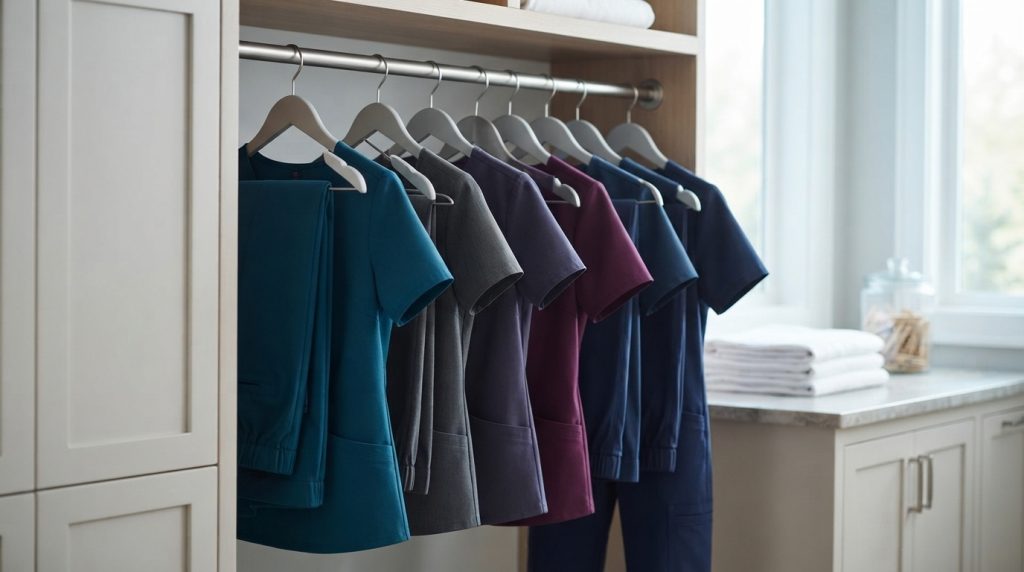
Quick-dry fabric
Quick-dry claims may be useful for workers who regularly launder several sets of scrubs.
IRG specifically identifies quick-dry performance in current EPIC product information.
Quick drying does not mean the garment can ignore normal washing instructions.
Follow the recommended care process.
Wrinkle resistance
A fabric that appears smoother after washing may reduce the need for additional garment preparation.
However, wrinkle appearance can be affected by:
- Wash cycle
- Drying method
- Drying temperature
- How long clothing remains folded or compressed
- Storage
Do not assume every polyester or performance fabric is automatically wrinkle-free.
How should healthcare professionals read a scrub fabric label?
Start with the fiber content and care instructions.
The FTC’s textile labeling guidance explains that covered textile products generally identify constituent fiber percentages by weight using recognized fiber names.
The FTC textile labeling guidance provides additional information about fiber-content disclosures.
Step 1: Read the fiber percentages
Look for materials such as:
- Polyester
- Recycled polyester
- Nylon
- Rayon
- Spandex
Do not immediately rank one blend as better.
Use the information to understand what is in the textile.
Step 2: Review the manufacturer’s performance description
Look for specific characteristics such as:
- Wicking
- Stretch
- Quick drying
- Wrinkle resistance
- Fabric weight
Separate specific characteristics from broad terms such as “ultimate” or “best.”
Step 3: Read the care label
Check:
- Washing instructions
- Bleaching instructions or warnings
- Drying instructions
- Ironing information
Follow the garment’s own instructions.
Step 4: Evaluate the actual fit
Move in the scrubs.
Sit, walk, bend, and reach.
A technically impressive fabric is not useful when the garment does not suit the wearer.
Which scrub fabric is best for long shifts?
There is no universal answer.
The best fabric for a long shift depends on the work environment and wearer.
For active healthcare roles
Workers who move frequently may prioritize:
- Stretch
- Lower garment weight
- Moisture management
- Secure fit
- Pocket function
For office-based clinical work
Professionals who divide their time between seated and clinical duties may prioritize:
- Comfortable seated fit
- Smooth drape
- Professional appearance
- Moderate stretch
- Layering
For workers who wear multiple layers
Consider the entire outfit:
- Underscrub
- Scrub top
- Jacket
- Lab coat
- Required PPE
NIOSH notes that clothing and PPE can contribute to occupational heat burden in hot environments, making it important to consider the complete clothing ensemble rather than one fabric layer in isolation.
Again, scrub selection is not a substitute for workplace heat-safety procedures.
Is soft scrub fabric always more comfortable?
Not necessarily.
Softness is a personal preference and only one part of comfort.
A very soft fabric may have excellent surface feel but still be uncomfortable when:
- The waistband slips
- The rise is incorrect
- The inseam is excessive
- The top pulls across the shoulders
- Pockets are badly positioned
Similarly, some workers prefer a more structured fabric because they like how it holds its shape.
Comfort is better understood as a combination of:
Fabric + Fit + Movement + Work Environment + Personal Preference
This is why two healthcare professionals can have completely different opinions about the same scrub fabric.
Should scrub tops and pants use the same fabric?
Matching tops and pants from the same collection can simplify coordination.
A coordinated collection may use related fabrics and colors across its garments.
However, healthcare professionals sometimes build mixed workwear wardrobes according to personal needs.
For example:
- A lightweight top with structured pants
- A tuckable top with stretch joggers
- Scrubs with a separate knit jacket
- A performance scrub set with an underscrub layer
Always check workplace color and uniform requirements before mixing garments.
Even color names that sound identical may not visually match across different collections or fabric types.
Common mistakes when choosing scrub fabric
Selecting only by fiber percentage
Fiber content is important, but garment construction affects the final wearing experience.
Assuming all polyester scrubs feel the same
Polyester-based fabrics can differ significantly in weight, stretch, construction, and finish.
Using “breathable” and “wicking” as identical terms
They describe related but different fabric considerations.
Buying the stretchiest option without checking fit
Stretch cannot fix an unsuitable rise or inseam.
Ignoring garment weight
A worker who layers frequently may have different fabric preferences from someone wearing only a scrub top.
Assuming soft means durable
Surface feel does not automatically predict long-term garment performance.
Ignoring the care label
Manufacturer care instructions should guide washing and drying.
Buying several sets before testing the fabric
Wear and evaluate an unfamiliar collection before building a large workwear rotation.
A simple scrub fabric comparison checklist
Before choosing medical scrubs, ask:
- What is the fiber content?
- Does the manufacturer identify stretch or moisture-management properties?
- How heavy does the fabric feel?
- Does the garment move during normal bending and reaching?
- How does the fabric feel when layered?
- Does the garment maintain appropriate coverage?
- Are the pockets practical when used?
- What do the care instructions require?
- Does the fabric suit the preferred structured or soft drape?
- Does the complete garment fit correctly?
Professionals who prefer to feel different fabrics and compare garment construction in person can also explore a local medical scrub store in Wilmington when evaluating workwear options.
Final Thoughts
Scrub fabric should be chosen according to the realities of the healthcare workday.
Breathability, moisture management, stretch, durability, and easy care describe different aspects of fabric performance. A garment may be strong in one area without being the best choice for every worker.
The most effective buying process is to examine the fiber content, understand the manufacturer’s specific performance claims, read the care instructions, and test the complete garment during realistic movement.
Do not choose scrubs because one fabric term sounds impressive.
Choose the combination of fabric and fit that suits the workplace, movement demands, layering routine, and personal comfort preferences.
Frequently Asked Questions
What is the best fabric for medical scrubs?
There is no single best scrub fabric for every healthcare professional. The right choice depends on desired stretch, fabric weight, moisture management, garment structure, work environment, and care preferences. The fit and construction of the complete garment are as important as the fiber percentages.
Are polyester scrubs breathable?
Polyester is used in many different fabric constructions, so fiber content alone does not determine the complete wearing experience. Fabric weight, construction, moisture-management design, garment fit, and layering can all influence how scrubs feel during work.
What is the difference between moisture-wicking and breathable scrubs?
Breathability generally refers to air or vapor movement through clothing, while moisture-wicking claims describe how fabric manages moisture against or away from the body. The terms should not automatically be treated as identical.
Are stretchy scrubs better for long shifts?
Stretch can support garment movement during sitting, reaching, and bending, but it does not correct an unsuitable size, inseam, rise, or cut. Healthcare professionals should evaluate stretch together with waistband security, pant shape, shoulder fit, and workplace duties.
How can I make medical scrubs last longer?
Follow the garment’s care label, avoid assuming every fabric can use the same wash and drying routine, and consider how pockets are loaded during work. Care requirements vary by garment, and the manufacturer’s attached instructions should guide routine cleaning.